
Towards a Mythopoetic Sovereignty
In the genealogy of narratives voicing the human condition, if mythology is the parent, mythopoesis is the progeny. Mythology embodies the paternal function constructed around archaic explanatory motifs, whereas mythopoesis is its child, remixing the myth-making as a contemporary counterpart to the father’s etiological tales. In his seminal comparative literary study distinguishing mythology from mythopoesis, Harry Slochower’s Mythopoesis delineates how myth is shaped according to the needs and characteristics of its time, emerging from the sociohistorical conditions that reflect its cultural context, while mythopoesis uses history as a launching point to recreate past stories through their symbolic meanings. Here subjectivity is valued, leaning on one’s imagination to formulate new interpretations that reflect a hermeneutics of sorts over an allegorical approach rooted in authority and ideology. Just as mythopoesis gains vitality and generativity through self-reflective processes situated in the context of time and place, psychoanalysis as an expression of mythopoesis follows the method of interpreting and reimagining Western ancient epics as symbolic functions of psychic structures. Whereas Greek mythology depicted the significance of family relations, cultural practices, societal structures, and moral order, Freud recontextualized the storylines as unconscious processes indicating a new cosmological order of instincts, developmental stages, and internal conflicts enacted in external drama. Mythology functions as a paternal structure that mythopoesis recreates and challenges, a dynamic further replicated in psychoanalysis itself. Freud’s use of mythological interpretation to substantiate his structural theories of mind, based on repression and libidinal drives, is contested by his collegial progeny. This is illustrated by Jung’s archetypal theory diverging sharply from Freud’s libido model, transforming their mentor-protégé bond into an irreparable, familial rupture. In his lineage that followed, Jean Laplanche critiques Freud’s biological model, distinguishing drive from instinct and demonstrating how psychoanalytic thought can sustain productive conceptual oppositions. These relational modes of differentiation are borne from the separation of inherited ideas, re-visioned by decentralizing the paternal power embedded in historical-cultural artifacts. When faced with initiatory themes of change in identity roles and transferences of power, the use of symbolic activation can usher in the creation of a mythopoesis working through a burdened mythology. Through the conceptual rendering of this confrontation from mythology to mythopoesis, Swedish visual artist Alexander Mood stages his inquiry of dismantling and reimagining the physical and symbolic relics inherited from his late father, an artist himself.
Upon encountering The Abdication, Mood’s sequential installation unfolds piece by piece as a filial rite of passage. Mood entices the viewer in his role as the subject of his dramaturgical interpretation and response to his father’s cryptic mythology, left for Mood to decipher. Oneiric and uncanny, The Abdication is a visceral and emotional transmutation of the blurring of personal and fictitious narratives materialized through sculpture, performance, video, drawing, painting, object juxtaposition, and ritualization. Visually and symbolically reminiscent of the alchemical stages of the Hermetic tradition, The Abdication conjures parallels to the 16th-century illustrations of esoteric motifs later rigorously translated as unconscious representations of psychological phenomena guiding the process of individuation by Jung and his scholarly collaborator, Marie Louise von Franz. But first, it is necessary to turn to the mythology from which Mood’s mythopoesis came to be.
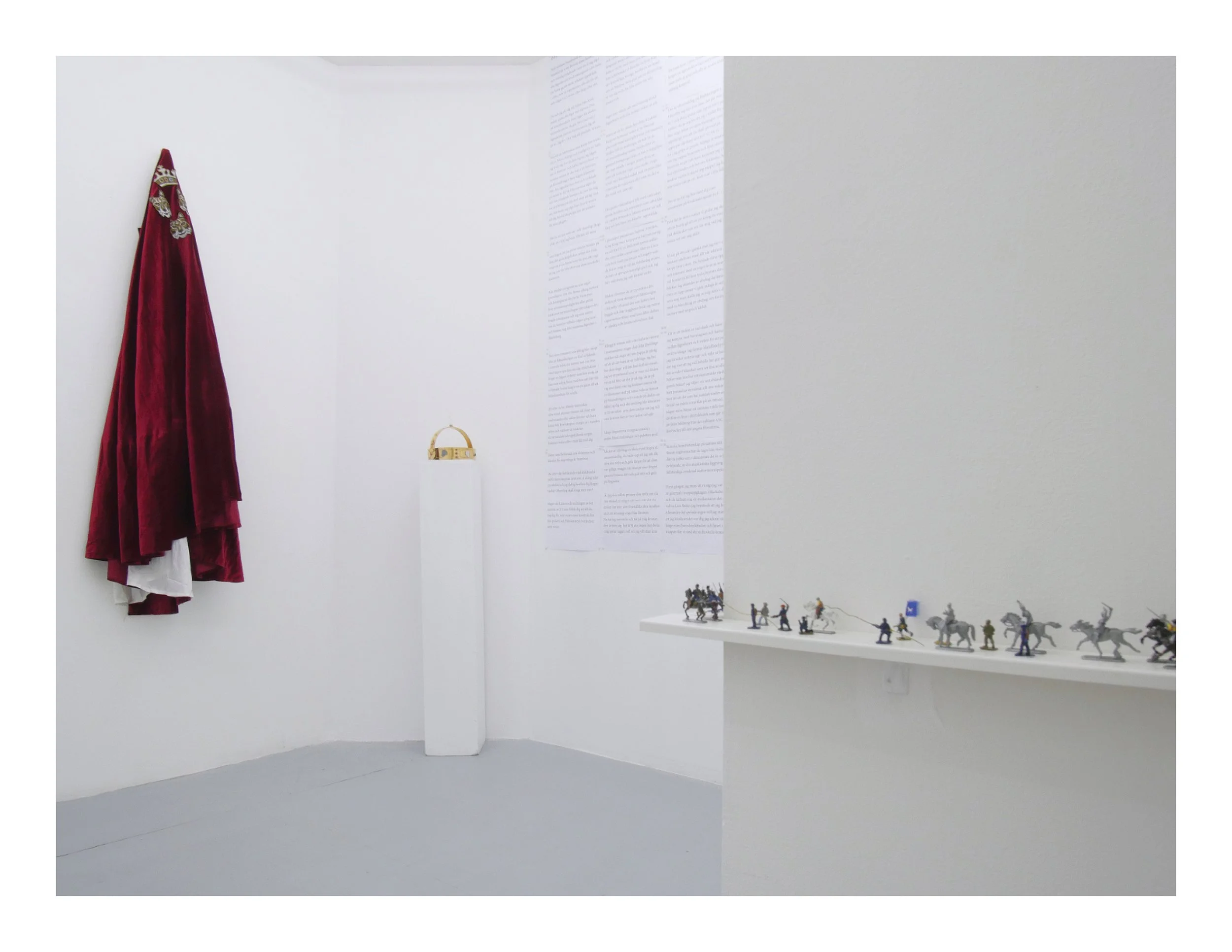
Following his father’s passing, Mood refrained from establishing meaningful contact with the collection of artifacts left to his name. A decade later, without the context required to understand the significance these objects held for his father, Mood committed to locating his own art practice within the confines of his father’s obsessional and illusory mind. In his discovery, Mood uncovered a menagerie of elaborate subplots centered around an empire his father titled Kingdom of Roma. Relics of this kingdom included military regime mementos preserved like precious family heirlooms, hundreds of plastic toy soldiers, handcrafted regal attire fit for a king, and archives of antique metal blades and watches. Among the fictional documents authored by his father, meticulous hierarchical systems were accompanied by detailed budgets and hand-drawn maps. Serving as archaeological remains in search of a cohesive narrative, Mood began forging a relationship to his father’s tactile remnants by finding a way into the Kingdom of Roma. Following his own instinctual and creative motivations to encounter the unabsolved gaps with his father, Mood sets forth to revise a mythology through an archetypal resurrection. Creating a visual corpus of The Abdication, he establishes his status of domain vis-à-vis becoming the paternal function of order as the king in his father’s imaginal world. And not without upholding his presence as a grieving son.
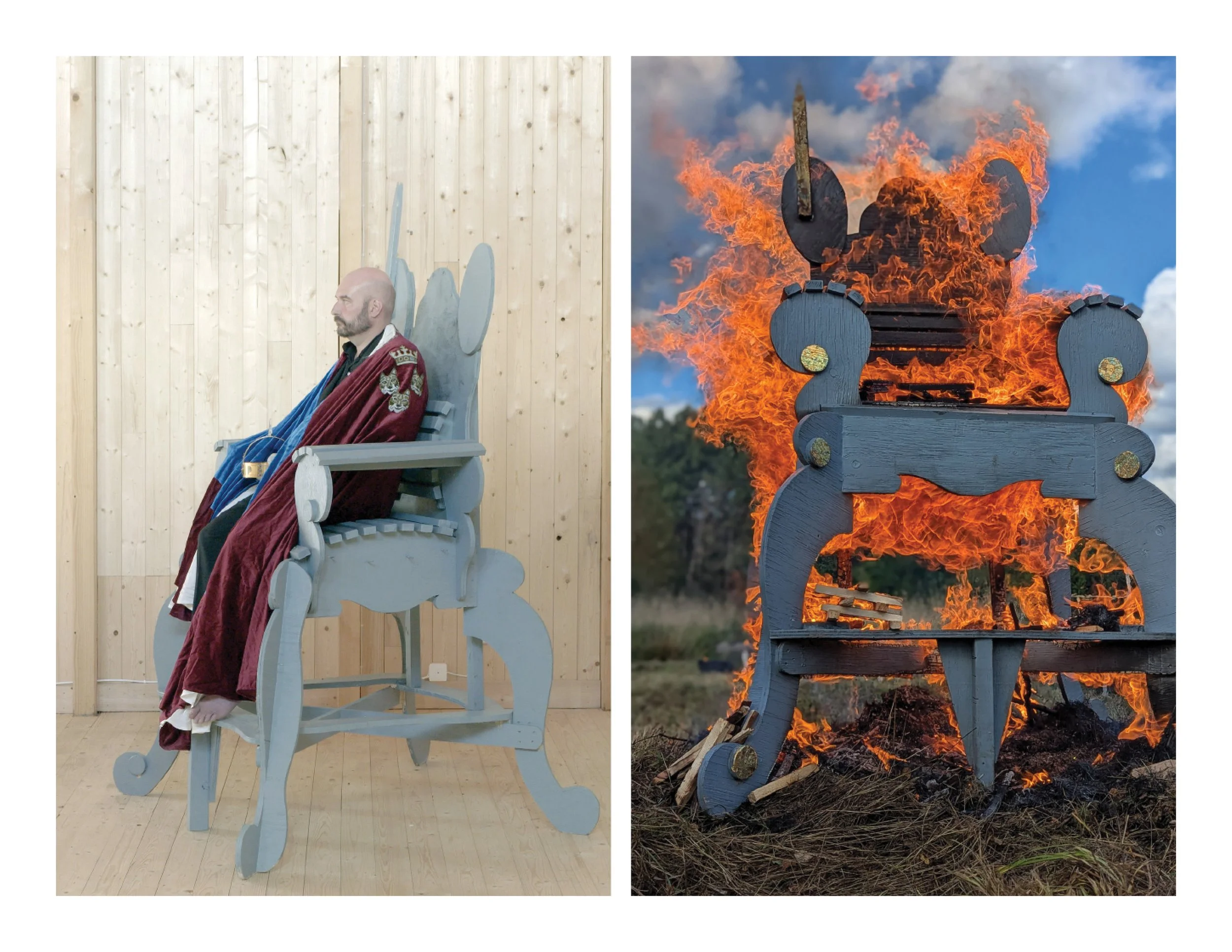
In the first act, Mood steps into the role of the king cloaked in his father’s royal mantle. Perhaps as an act of refusal towards the old guard, the king is barefoot, with his crown strategically placed on the lap instead of his head. Recalling Shakespeare’s Henry IV reflections of power, the immortalized idiom “heavy is the head that wears the crown” seems fitting as the staged gesture holds the tension between separating from and identifying with the burden. Set inside a stark wood-paneled room, the king looks ahead while sitting on a large-scale throne, evoking an infant’s high- chair accentuated by the large gap between the floor and bare feet. This throne, however, has a compelling reference. Designed after Kristina, Queen of Sweden’s seat of power, as the only surviving child of a king, Kristina was forced to carry on the regal family legacy as a female educated as a prince in the 17th century. After a decade of prolific rule, she abdicated the throne, rejecting the status quo of marriage along the way and pursuing her legacy as a nonconformist and patron of the arts. Seated upon her majesty’s throne, the king looks beyond the viewer's gaze, establishing a sense of emotional and physical distance while inviting curiosity about what lies beyond his field of vision outside of the boundaries of the frame. The king’s elevation and isolation prompt an archetypal function in psychological suffering as a catalyst for resilience and meaning. Jung offers a perspective on the role of the king upon his discovery of the alchemical tome The Rosarium Philosophorum: “The alchemists took a more optimistic view: the dark background of the soul contains not only evil but a king in need of, and capable of, redemption.” Redemption is referenced through the alchemists’ language describing how the king, despite the ash that must be endured, continually walks through the fire, radiating like the sun. These residual remnants of destruction represented as ash do not deter from continual movement through the flames of psychological transformation. Rather, this detritus is integrated with the source from which it comes. In this way, Mood constellates a path forward for the conflicted king through his own redemption, achieved by integrating the masculine and feminine principles of self-assertion and creativity. This reconciliation is symbolically enacted through the summoning of Queen Kristina and his self-presentation as the unorthodox king, offering a new vision of inner sovereignty outside of his father’s envisioned monarchical structures of political order as evidenced in the artifacts left behind. From an alchemical perspective, the annihilation of the king is a signal of internal structural change as posited by Edward Edinger: “The death of a king is a time of crisis and transition… psychologically it would signify the death of the ruling principle of consciousness, the highest authority in the hierarchical structure of the ego. Death of the king would thus be accompanied by a regressive dissolution of the conscious personality… After a descent into hell, the ego (king) is reborn, phoenixlike, in a purified state. This process of dissolution and renewal can also be understood through the Mood’s own physical and psychological positioning as the king in dissolution, contending with his identity as the artist’s son.
Concurrently, Mood’s occupying the oversized throne in solitary evokes a reflective stance. The perspective of a son longing for a father absorbed within a narcissistically oriented inner kingdom. The rules of this domain favor artistic pursuit and intellectual preoccupation over the responsibilities of parenthood. The work suggests how the libidinal drive toward artistic creation can become an all-consuming force, eclipsing paternal presence and leaving the son's emotional needs subordinate to the father's ambitions. In response to this paternal absence, the son’s own inward withdrawal becomes a means of constructing a new symbolic order founded on self-reliance, creative refuge, and an identification with the father’s artistic identity as a means of seeking validation.
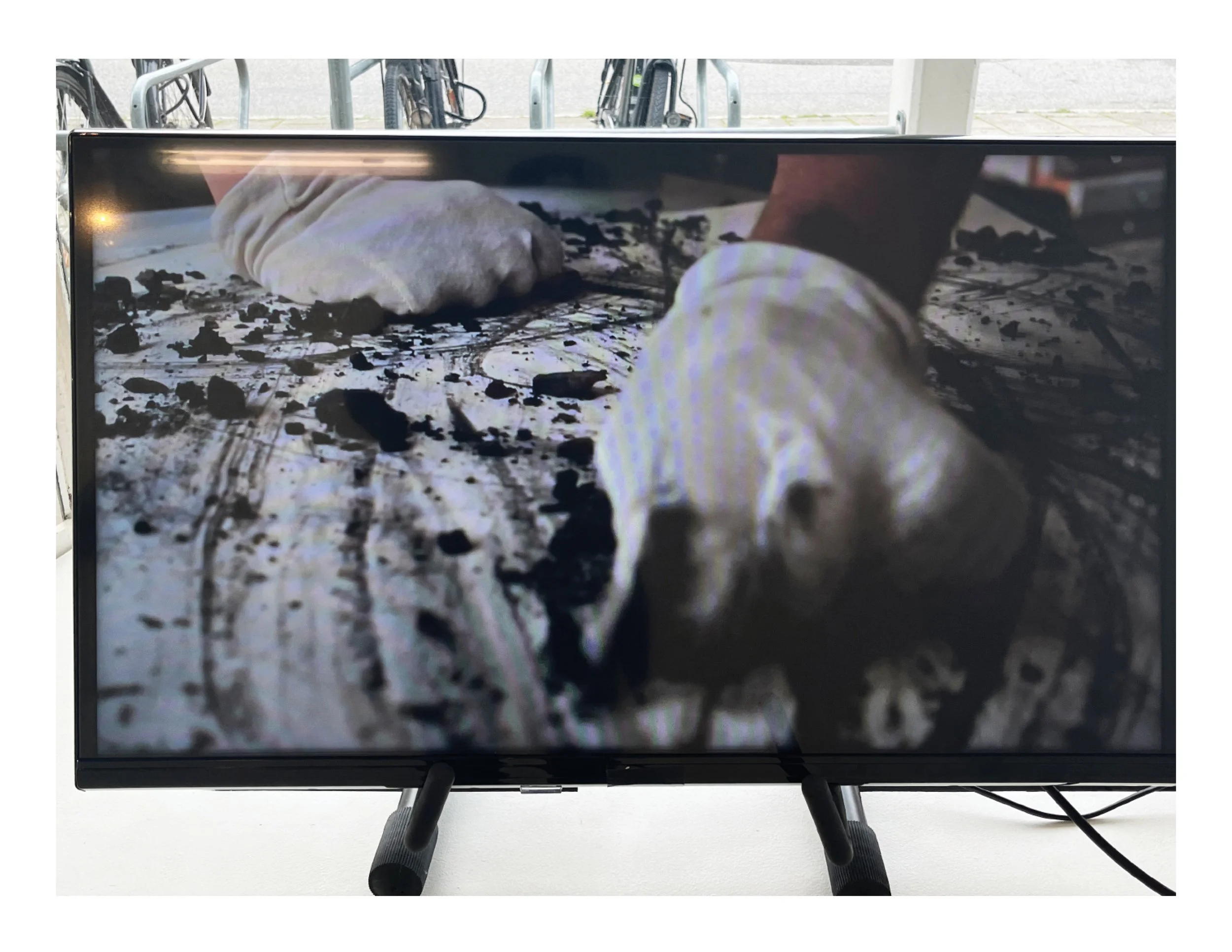
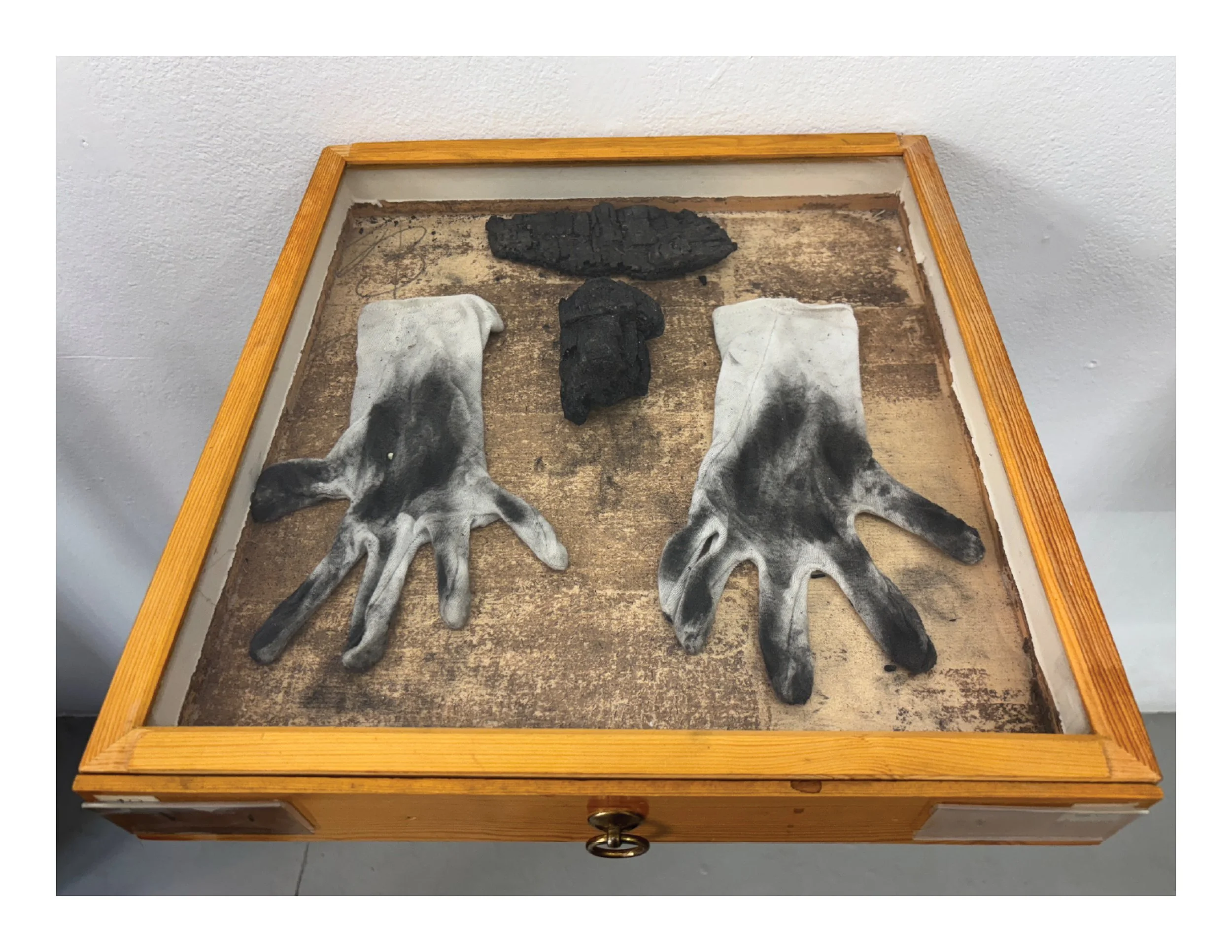
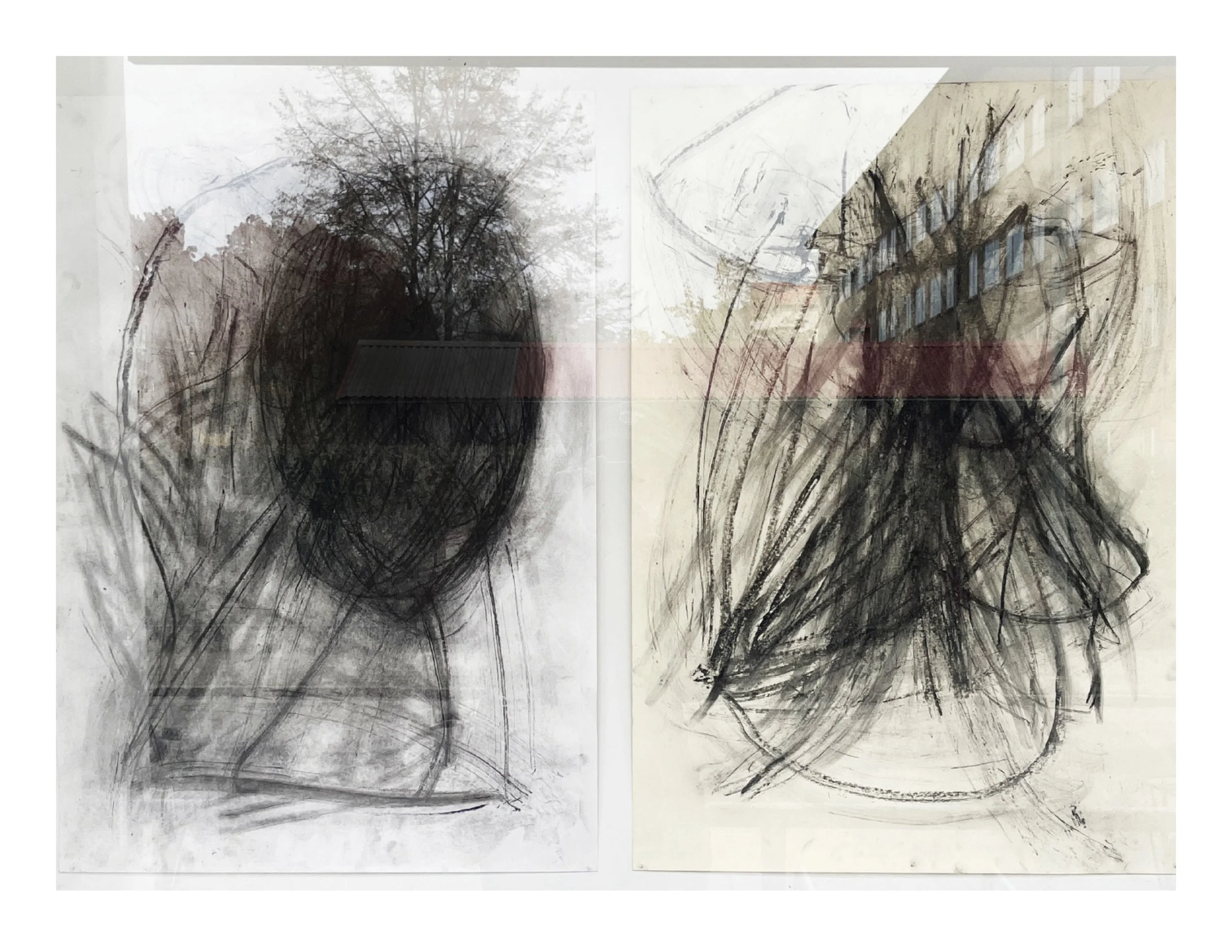
Shifting from inward contemplation to outward ritual action, the performer guides the viewer toward a confrontation with untamed natural forces. In the filmed performance, Mood again assumes the role of the king, entering the landscape where the throne awaits as the site of ritual transformation. There, he ignites the throne in an all-consuming fire, creating a moment that embodies the simultaneous forces of purification and destruction. The fire as a stage of calcinatio allows for the dissolving of illusions, coupled with the release of combustible emotions. Within this tension, the symbolic union of king and queen is reconciled through their sacred conjunction, enacting the alchemical task of base matter toward spiritual wholeness. Captured as a still image, Queen Kristina’s throne engulfed by the king’s flames functions as an anti-portrait of the sacred union, or coniunctio, restoring harmony after the crisis. Paradoxically, fire operates as an ambivalent force, expressing the masculine impulse toward violence while embodying the feminine capacity for generativity and renewal. In his musings in The Psychoanalysis of Fire, Gaston Bachelard writes, “To be deprived of a reverie before a burning fire is to lose the first use and the truly human use of force. To be sure, a fire warms us and gives us comfort. But one only becomes fully aware of this comforting sensation after quite a long period of contemplation of the flames; one only receives comfort from the fire when one leans his elbows on his knees and holds his head in his hands. This attitude comes from the distant past. The child by the fire assumes it naturally… when near the fire, one must be seated; one must rest without sleeping; one must engage in reverie on a specific object.” Mood successfully induces the shared reverie informed by discernment that Bachelard posits, inviting a contemplative encounter between imagination and inherited meaning. The Burning Throne challenges the narrative of succession by presenting the son as king into a conscious state that can tolerate the shadow of the father, without being sentenced to repeat the father’s mythology. Mood then reconstitutes the lost parental role within a ritualized contemplation of the symbolic sacred marriage of the archetypal king and queen while situating the viewer as the parental role. The viewer is implicated in this psychic terrain, digesting Mood’s own confrontation with paternal absence. Following the immolation, Mood collects the ash and pushes the storytelling of his individuation myth-making in a succeeding performance using the soot as the medium for a series of drawings. Mirroring the alchemical stage nigredo, the decomposition purified into its rawest form, the coal material spawned from the sacred marriage of The Burning Throne becomes a series of new works including preserved artifacts displayed in conversation with the objects from Mood’s father’s collection. Smudge-stained archival cotton gloves protected behind glass sit alongside glass vessels of the batch of soot. Settling into this aftermath of stillness allows for the activity of Mood’s frenetic scrawling to be further synthesized as a stage of completion.
The Abdication functions as a methodology in which Mood separates himself as the subject through his own imagination through performance and documentation, inviting the viewer to partake in creating a shared reality. Drawing on Play and Reflection in Donald Winnicott’s Writing, André Green argues that attentive recognition organizes the self. Beyond psychoanalysis, this mirroring extends to artist and viewer, where ritualized observation creates internal change. Having experienced the separateness of his father’s reality, what started off as a desire to discover more about his father’s mind led him and the viewer into a procession of Mood’s rich inner life. Returning to the father, Freud offers the reminder that art provides “a path from phantasy back again to reality”. Following his own phantasy, Moods invites himself and the viewer back to reality, this time together.
By Dana Kline PhD, Los Angeles, 2026.
———————-
References:
Bachelard, G (1964). The Psychoanalysis of Fire. Translated by Alan C. M. Ross, Beacon Press.
Edinger, E. F. (1985). Anatomy of the psyche: Alchemical symbolism in psychotherapy.
Open Court Publishing Company.
Freud, S. (1909) Letter from Sigmund Freud to C. G. Jung, April 16, 1909. The Freud/Jung
Letters: The Correspondence Between Sigmund Freud and C. G. Jung.
Freud, S. (1963). The paths to the formation of symptoms. In J. Strachey (Ed. & Trans.),
Introductory lectures on psycho-analysis (Vol. 16, pp. 358–377). The Hogarth Press.
(Original work published 1917).
Green, A. (2005). Play and Reflection in Donald Winnicott’s Writings (1st ed.). Karnac Books.
Jung, C. G. (1967). Paracelsus as a spiritual phenomenon. In Alchemical Studies (The Collected
Works of C. G. Jung, Vol. 13, pp. 109–189). Princeton University Press.
Laplanche, J. Osborne, P and John Fletcher,J. 'Jean Laplanche: The other within - Rethinking
psychoanalysis', Radical Philosophy 102, Jul/Aug 2000.
Slochower, H. (1970). Mythopoesis: Mythic patterns in the literary classics. Wayne State
University Press.
———————-
Image List:
All images courtesy of the Artist unless otherwise noted.———————-
Alexander Mood is a contemporary multidisciplinary artist and musician based in Stockholm, Sweden. He holds a B.A. from the National College of Art and Design in Dublin. Mood is widely known for conceptual and performative artwork, often exploring themes of identity, lineage, and imaginary kingdoms.