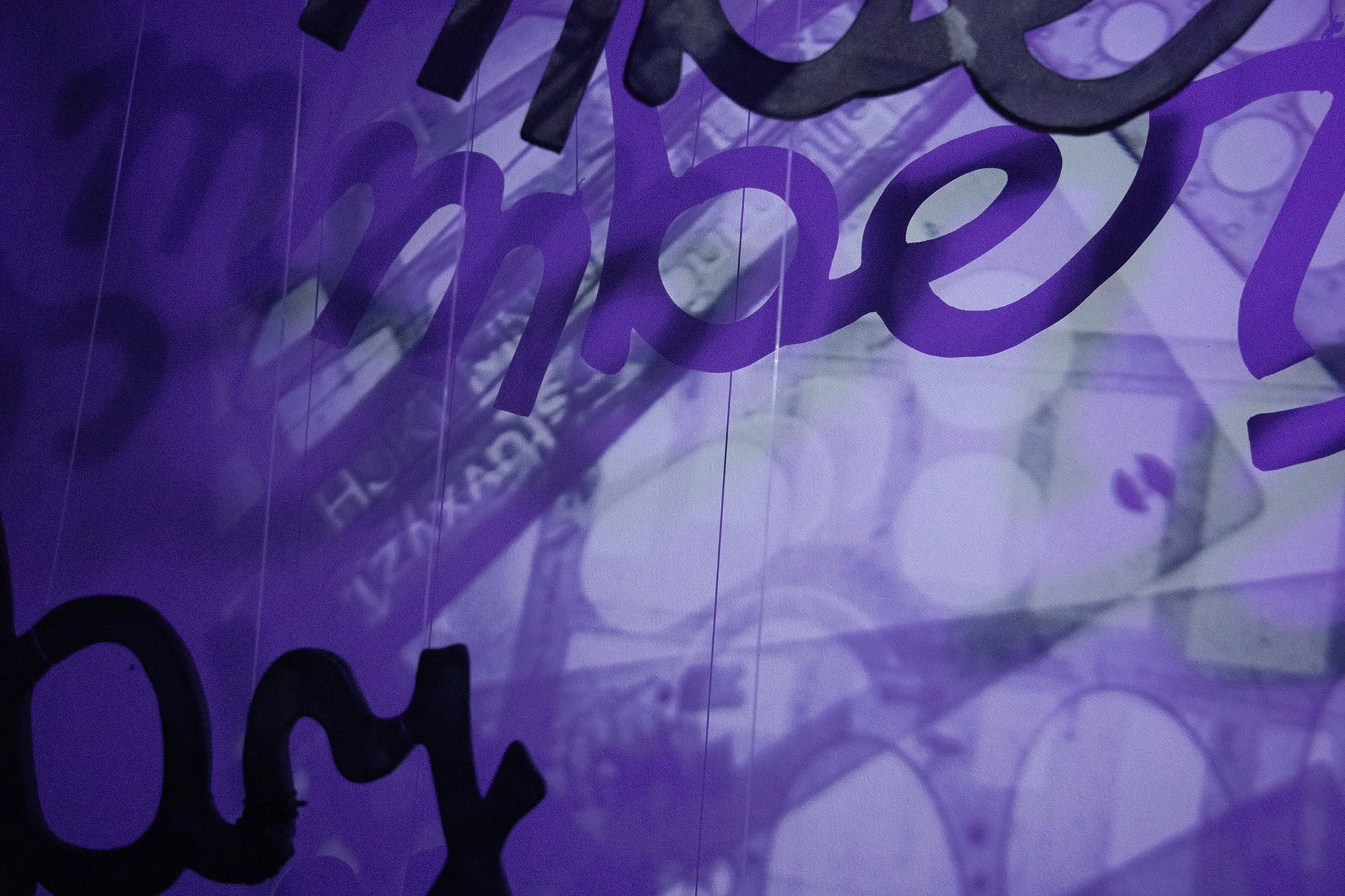
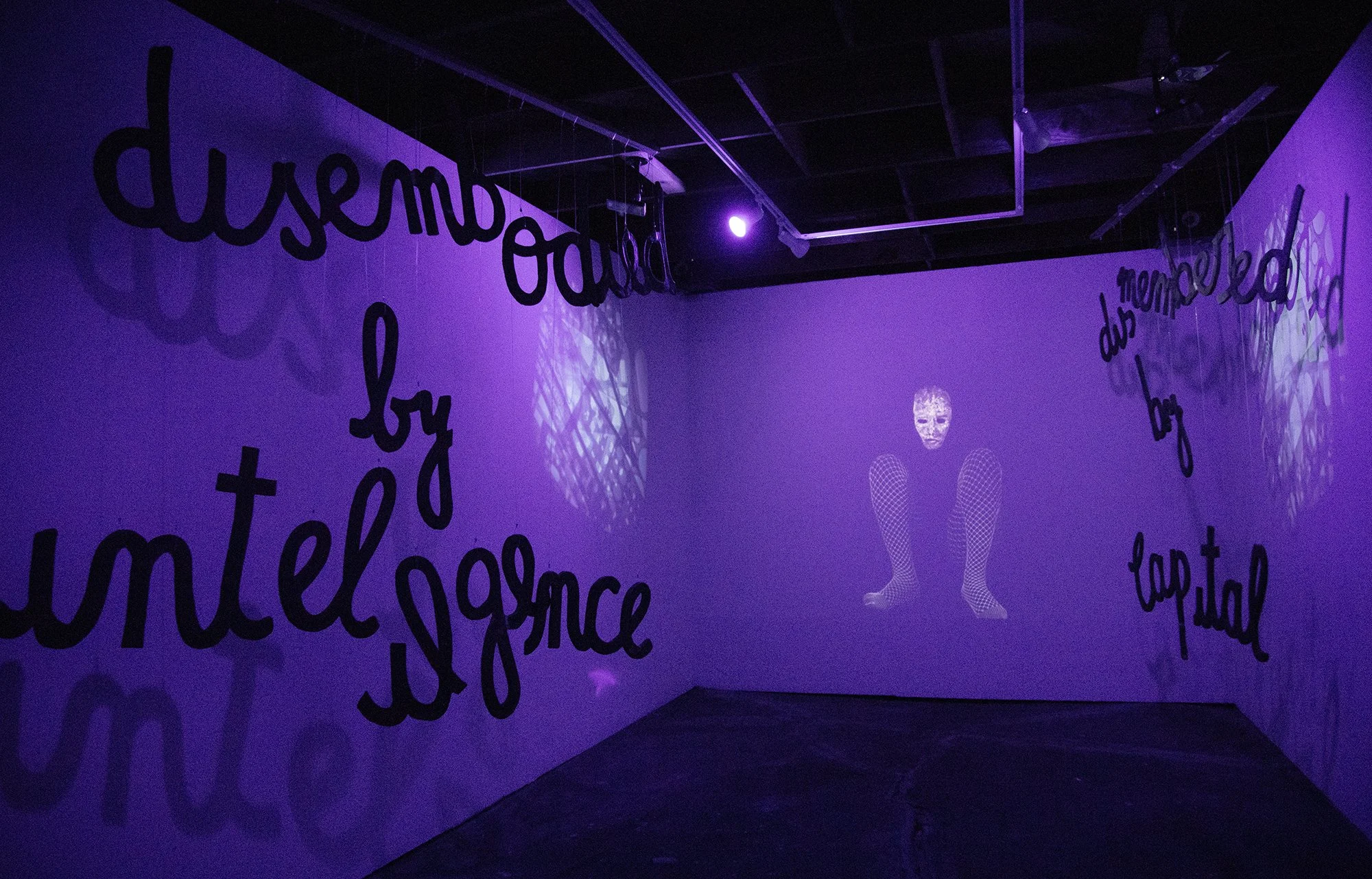
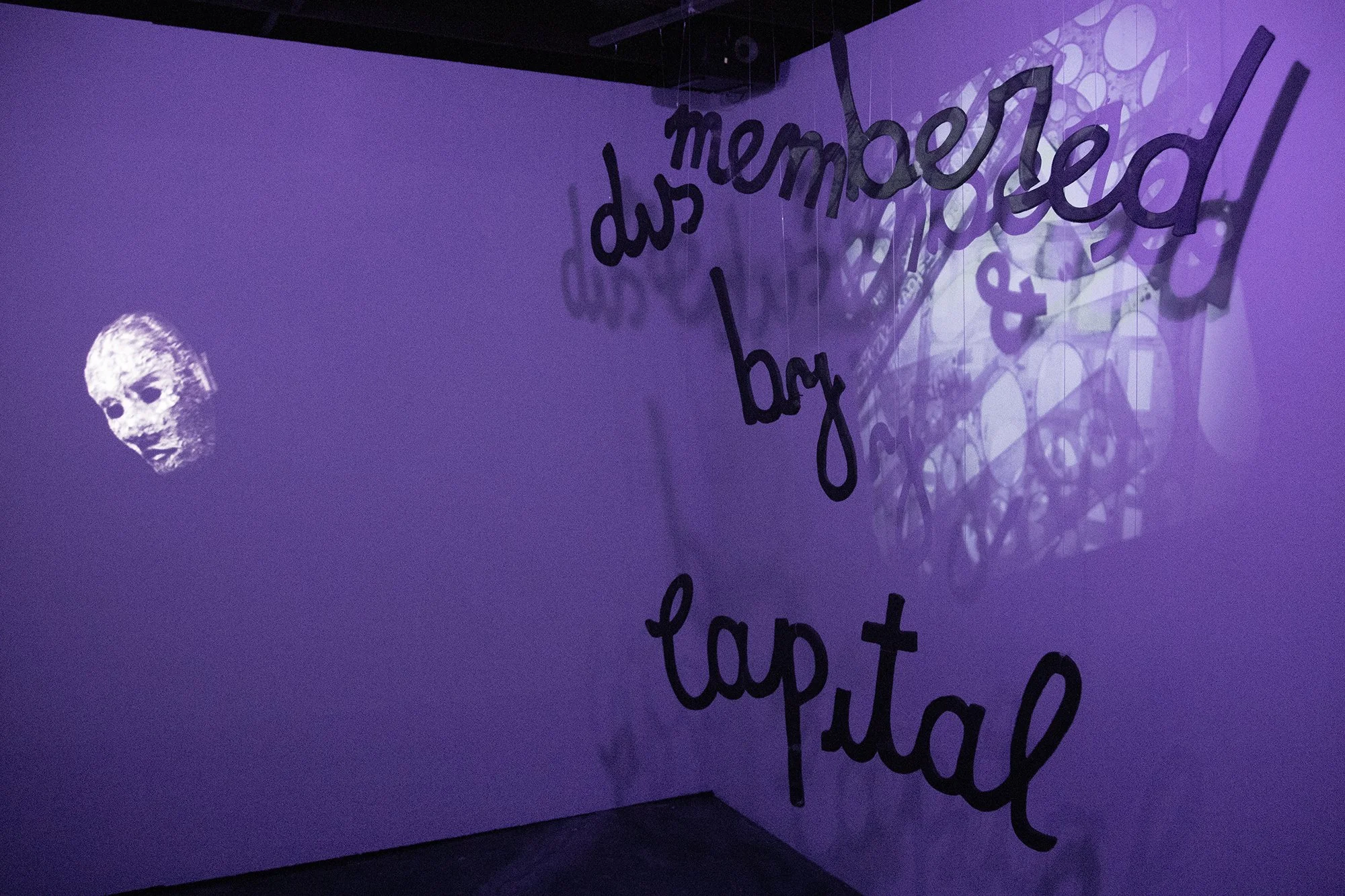
The double doors of the Winslow Garage crack open and I emerge on the other side of the curtain, propelled into a universe, lit by blacklight; the din of machinery conjuring sounds of construction or a clock immediately invades my senses. Facing me are projections of letters and architectural drafting tools being moved on an overhead projector bed. On two opposite corners of the space, ceramic phrases in cursive are suspended, spelling out “dismembered by capital” and “disembodied by intelligence". The sculptural words cast shadows over the projections, providing additional layers of letters obscuring one another. A pink granular mask appears by the letter ‘d’ of “disembodied", crouching on fishnet legs, taunting me. This nightmarish hall of mirrors feels like a sharp rupture from the world of Silverlake homes and bright Californian sunshine that I have left behind. There is no sense of direction or linear narrative: one is assailed from all sides.
Disembodied by Intelligence is a new work by Carmen Amengual in which she continues to explore the appropriation of language by those in power, within the context of our increasingly fascist and technocratic world. Similarly to the original video work, Sketches for a Piece on Language and Power (2024), the aesthetics of early cinema and analog illusionist strategies deployed by the artist provide a critical framework for the pageantry of democracy in right-wing propaganda. Although a worldwide phenomenon, the excessive use of the word ‘freedom’ in Trump’s celebration of the 250th anniversary of the founding of the United States, reveals something monstrous in our current democratic system. I am using this word in both the sense of a threat and in a mythological sense, of a hybrid being between the digital and the embodied. If the representation of democracy is reduced to a series of slogans and repeated imagery, how does it differ from totalitarian propaganda? What happens to the rational citizen inside an individualized, virtual reality? Faced with these monsters, how can art seek to reconstitute a sovereign subject and an empowered community?
The word ‘FREEDOM’ as it appears in one of the video projections, is a string of letters that gradually disappears into an open mouth. The word seems to be force-fed rather than assimilated. In this way, the White House accurately presents the celebration of the 250th anniversary of the US: neither the words 'democracy’ nor ‘republic’ appear on the event’s website. Trump seemed to have already dismissed the idea of a government for the people, by the people, instead, highlighting the words ‘independence’ and ‘freedom’. The very name of the organizing party, Freedom 250, asserts that the concept is a fait accompli, another product to be consumed. Freedom 250 is, in fact, chaired by Trump, housed inside the National Parks Foundation, funded by taxpayer dollars and private donations. It took over planning for the 250th-anniversary celebration from the bipartisan nonprofit America 250, which Congress signed into law in 2016 [1]
The words once cherished in our political system are being appropriated and weaponized. Freedom without democracy, for instance, serves as a justification for violence and exploitation, as recent US attacks on Venezuela and Iran testify. We who live in a Western liberal democracy take for granted that democracy will always be there. What is disquieting is our firm belief that it is the best system of governance. Akin to child's play, Amengual demonstrates that the meaning of democracy itself is unstable. In a vignette, the letters spelling ‘DEMOCRACY’ are scattered on an overhead projector bed amidst architectural drafting tools. The letters are being pulled apart by these tools, rendering the word less and less legible. The tools we’ve relied on to maintain our democratic system- electoral vote, division of powers, representative governance, are no longer working. The mobile phrases, casting their shadows over the tearing apart of ‘DEMOCRACY’, foreground the failure of the democratic system in the language of torture: “dismembered by capital” and “disembodied by intelligence". What kind of “intelligence” is developed by “capital”? How did we move away from rational values and individual rights promised by the Enlightenment? Or rather, how did those values lead us to become disembodied, passive subjects?
Last winter, I took a seminar series with Nigerian posthumanist philosopher Bayo Akomolafe, entitled Ghostlight of the Political [2]. Over six sessions, Bayo blends myth, folktales, and microbiology to challenge our preconceived notions of Western democracy. The photograph of the Lincoln Memorial from 1917 shows the Neoclassical-style building in the distance while the foreground is a wild, unruly marshland. According to Bayo, even though the builders have paved the marshland, the swamp's ecosystem still pervades the marble of the Memorial. This anecdote may appear apocryphal until one reads the recent news that the Reflecting Pool outside the Memorial keeps getting invaded by algae, turning the promised “American flag blue” water an unsettling green. It is not surprising that Trump is once again behind this attempt to beautify America's symbols. Democracy is built on unstable grounds, a permeable system at risk of contagion. But the contagion is not what is threatening democracy. Rather, it is the attempt to remove what seems impure to conserve the purity of the image that leads to the monstrous. Indeed, according to Euan Reavie, a phycologist based in Minnesota, the algae found in the Reflection Pool is “a ‘community of non-toxic green algae, very likely fed by abundant nutrients from the water source.” Why would this harmless community, this life force that springs out from the inert marble, be perceived as undesirable?
A hand places each letter spelling ‘LIFE’ in reverse order and, in one gesture, swoops it off screen with an elegant French curve. In another vignette, two figures pull on a string, from which is strung the word ‘MEMORY’ over a field of scattered letters. They try to communicate silently to one another; their action of pulling and letting go destabilizes the reading of the word. These two words, ‘MEMORY’ and ‘LIFE’, seem absent from political discourse. Can they be an antidote to the corrupted “democracy” and “freedom”? While the meanings of the latter are being undone by totalitarianism and abuse of power, their malleability also offers the occasion to redefine what the terms mean. If the political arena falls short of the capacity for change, it is within art- the realm of beauty and ideas- where new possibilities can be fostered. Human memory is intrinsically personal and subjective, changing throughout a person’s lifetime. Due to its non productivity and inefficiency, it may decelerate the path led by rationality towards the domination of digital technology. Digital technology will not make decisions based on the remembrance of a past failure, nor will it center ‘life’ as a core value towards which policies and economic decisions can be made. Totalitarian governments, past and present, have heavily relied on this practice of general amnesia. Memory is the final gateway, the giving over of our connection to ourselves. The word ‘DEMOCRACY’ is finally assembled with the intervention of human hands. The same hands scramble and reassemble the word. The backbone of democracy is demos, from the Greek, ‘people’, and I would further argue, a ‘community of people’ coming together with shared values. The system cannot function on representative governance alone. It is the people who have the power to decide the direction we move collectively in this nation, without whom we are handing over power to a privileged few. These hints of the possibility of life beyond the conditions we live in shift the work's meaning from a mere political criticism: the artist herself is mourning and suffering through the collapse of her own philosophical and moral beliefs. To regain her humanity, she must come face to face with the monsters of our inherited system.
A myth Bayo introduced to illustrate Western democracy is the Minotaur. Theseus represents the shining light of enlightened democracy, killing the monster within the labyrinth. What he did not know, Bayo added, was that by opening up the labyrinth, he let out the children of the Minotaur into the city, these hybrid creatures, between human and animal. They permeate our institutions, biding their time in the shadows. In Amengual’s work, these hybrid creatures take the form of disembodied masks. Described by the artist as our virtual avatars, the masks exist in an ambiguous space between the digital and the analog. Sometimes they float in an undefined dark space, the blackness of the theatre, and other times they are donned with legs. Each system of government is accompanied by its own set of technology. While the Industrial Revolution called about the change of government from absolute monarchy to a bourgeois democracy, our digital technology seems to be a return to oligarchy under the guise of democracy. With social media and other online platforms, the public sphere shifted from the physical space, where people from different backgrounds and political beliefs may rub shoulders, to individualized cells, personalized by algorithms, that allow each individual to construct their own reality. In contrast to the hands moving the words, the masks loom on their own. They face the viewer, taunting them wordlessly. In one scene, we see two cardboard masks with horns, giving way to the original, featureless mask. The horned masks contain an element of the carnivalesque, with devil-like features. The Carnival of Tilcara in Northern Argentina, where the artist is from, for instance, celebrates the disinterment and burial of the devil, as part of the festivities before Lent. Combining Catholic rites and indigenous pagan beliefs, it is believed that the devil descends from the hill and mingles among the villagers. Carnival participants put on horned masks and partake in dancing and merrymaking, unable to distinguish who the devil is. The devil allows for liberation from inhibitions and joy before a period of abstinence.
Although there is something menacing about the masks in Amengual's work, their handmade aspect contrasts with their digital reference. Indeed, Amengual wore the masks herself, in imitation of how digital animation moves. She likens this process to the trend of applying make-up to look like Instagram filters. The back-and-forth between the analog and the digital, in a game of mirroring, makes it difficult to locate the human, yet it is also a primal impulse for humans to mimic other species or supernatural creatures to enter into relation with what we cannot fully grasp. In Gustaf Palm’s article, “The Dragons are in the Machines” [3] on Substack, the author likens our age-old traditions of reverence for the metaphysical to how we should treat AI. He gives the example of “The medieval peasant who left cream out for the fairies [...] maintaining a relationship with a force he encountered in his daily life, a force that sometimes helped and sometimes hindered, that could not be controlled but could be related to.” How would we act differently to machines and AI, if we could consider them as part of our network of kinship? The play with masks, the encounter with the monstrous, is a reckoning with humanity’s own death drive: our capacity for mass destruction, the impossibility of life on the planet, caused by the depletion of natural resources our technology demands, and ultimately the loss of political agency, given the tools of our current democratic system. The blue mask with legs vomits out the alphabet: our language no longer bears meaning. The real monster is our own desire to become an image, not as individuals situated in history, moving towards a future. We can criticize the politicians, the billionaires, the tech tycoons and others who have more power than we do. But ultimately, we have succumbed to the drugs that they have given us, the seduction of a virtual life on the screens.
During our conversation in 2024, Carmen shared with me her thoughts on a new radical humanism, one that would allow us to be in community with people we don’t necessarily agree with and art’s role in bringing about that imagination. After revisiting the work, I started to ponder what constitutes ‘community’. While the installation implicates the viewers by casting their shadows across the projections, we do not exist solely in a human-centric world. Community may as well refer to invasive algae and AI. The artist becomes a mediator whose role is to rearticulate this multifaceted reality, handing us the mirror through which we may access the other side. To re-embody intelligence, she returns us to the hand as a connection between our thoughts and the reality around us. The shadow plays, the handmade masks, the hand-built ceramic mobile sculptures, in turn, taunt the pervasiveness of digital simulation of life by insisting on the nature of human life in relation to all things.
By Prima Jalichandra-Sakuntabai, October, 2026.
———————-
References:
[1] https://americanoversight.org/analysis/america250-freedom-250-corruption/
[2] https://www.macalester.edu/global-citizenship/engagement-with-bayo-akomolafe/
[3] https://darkmountainproject.substack.com/p/the-dragons-are-in-the-machines
———————-
Image List:
Installation documentation at Winslow Garage. Courtesy of Prospect Art.———————-
Carmen Amengual (Buenos Aires, 1979) is a multidisciplinary artist, filmmaker, and independent researcher. Her practice draws on fragile archives, micro-histories, and oral narratives to investigate how stories of resistance circulate and transform over time. Through experimental cinema, installation, and critical research, she activates incomplete or forgotten materials —unrealized scripts, unfinished projects, and buried collective and individual dreams— situating them in the present and opening them to experiential dimensions capable of projecting new futurities. Her work engages with historical and family archives, as well as myths, oral accounts, and literature, to explore the intersections of political memory, biography, and history. Informed by feminist and anti-colonial methodologies, she examines the ruins of emancipatory cultural imaginaries and the forms of sociability, pedagogy, and friendship they sought to create. Her projects span film, sculpture, sound, text, and installation, unfolding layered narratives in which the historical and the speculative converge to reimagine the ties between past and future.