About Sediments by Anna Ridderstad
“You are threaded through with fossils. Your microbiome is an ode to bacterial legacies you would not be able to trace with birth certificates and blood lineages. You are the ongoing-ness of the dead.”
— Sophie Strand. Your Body Is an Ancestor
Thresholds
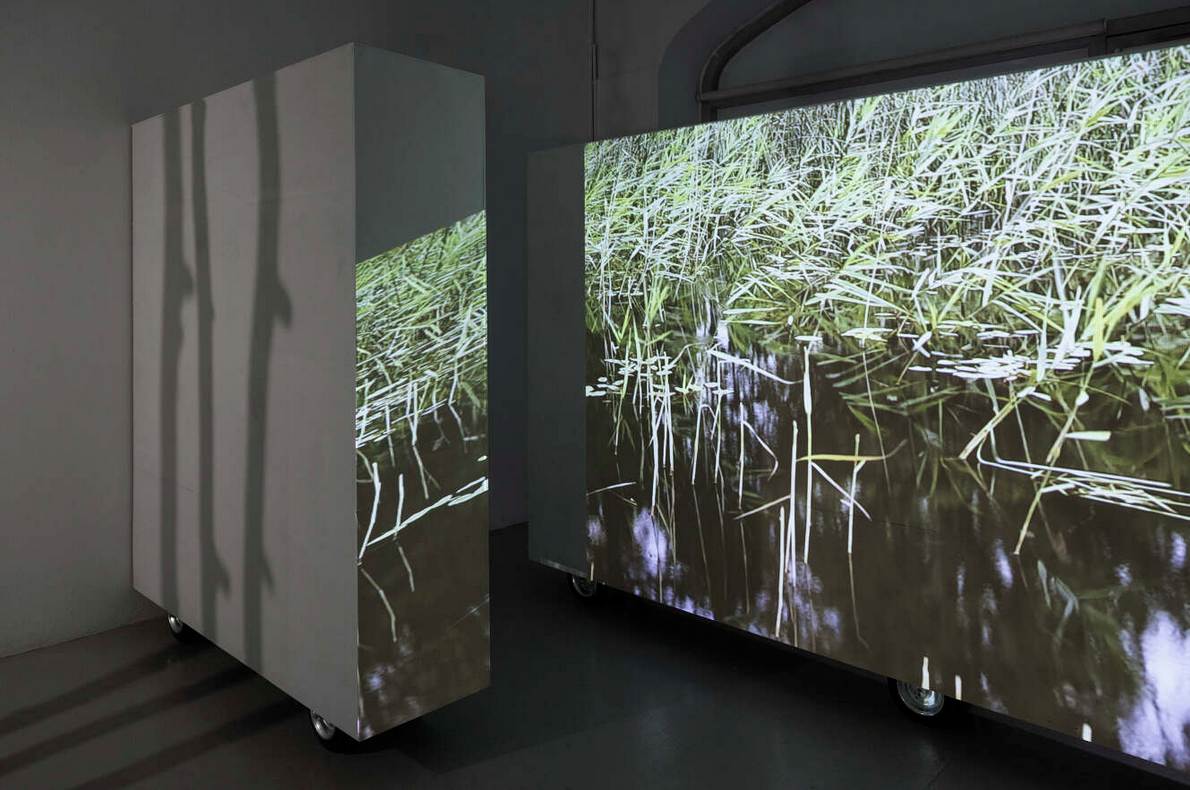
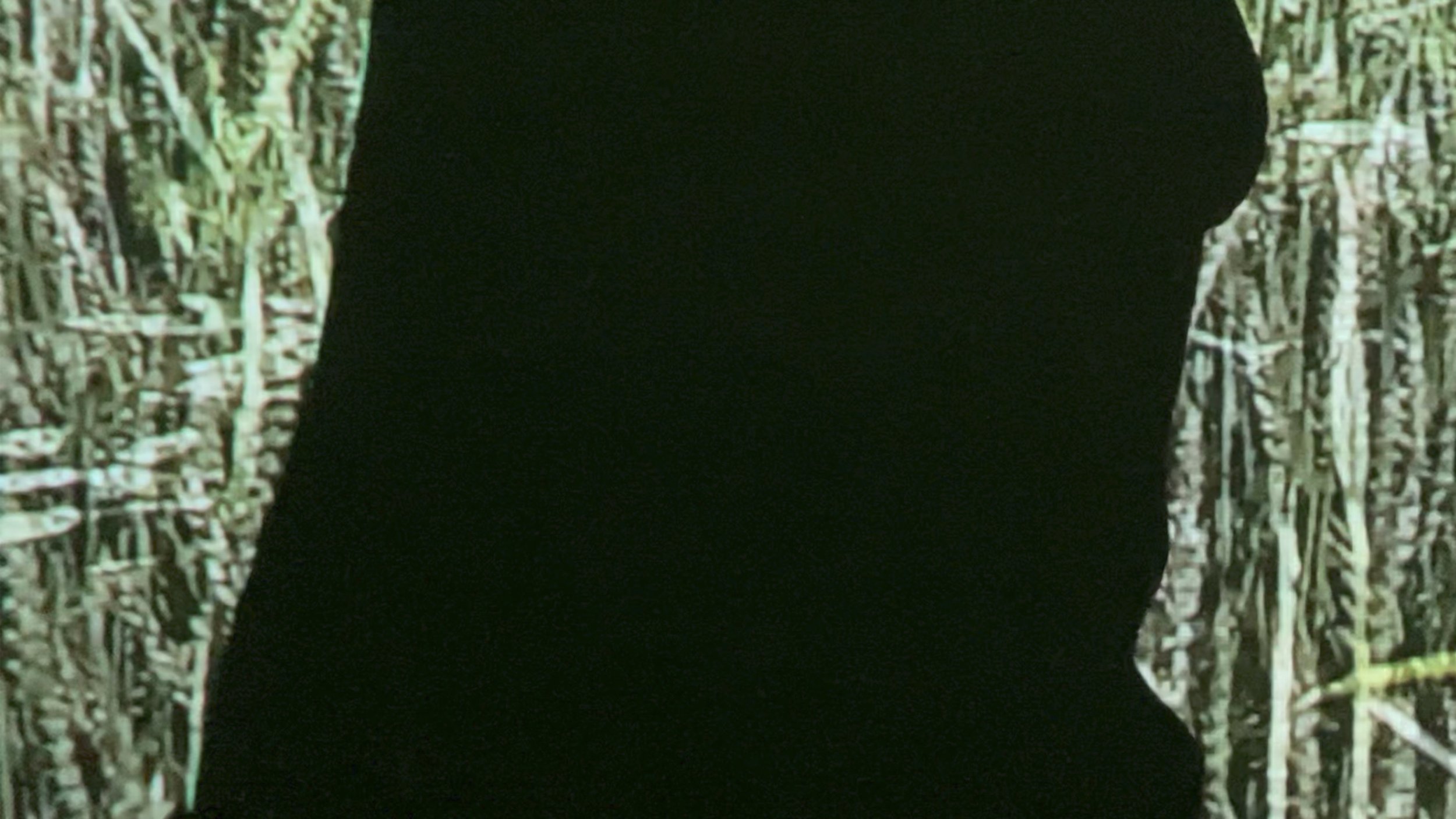
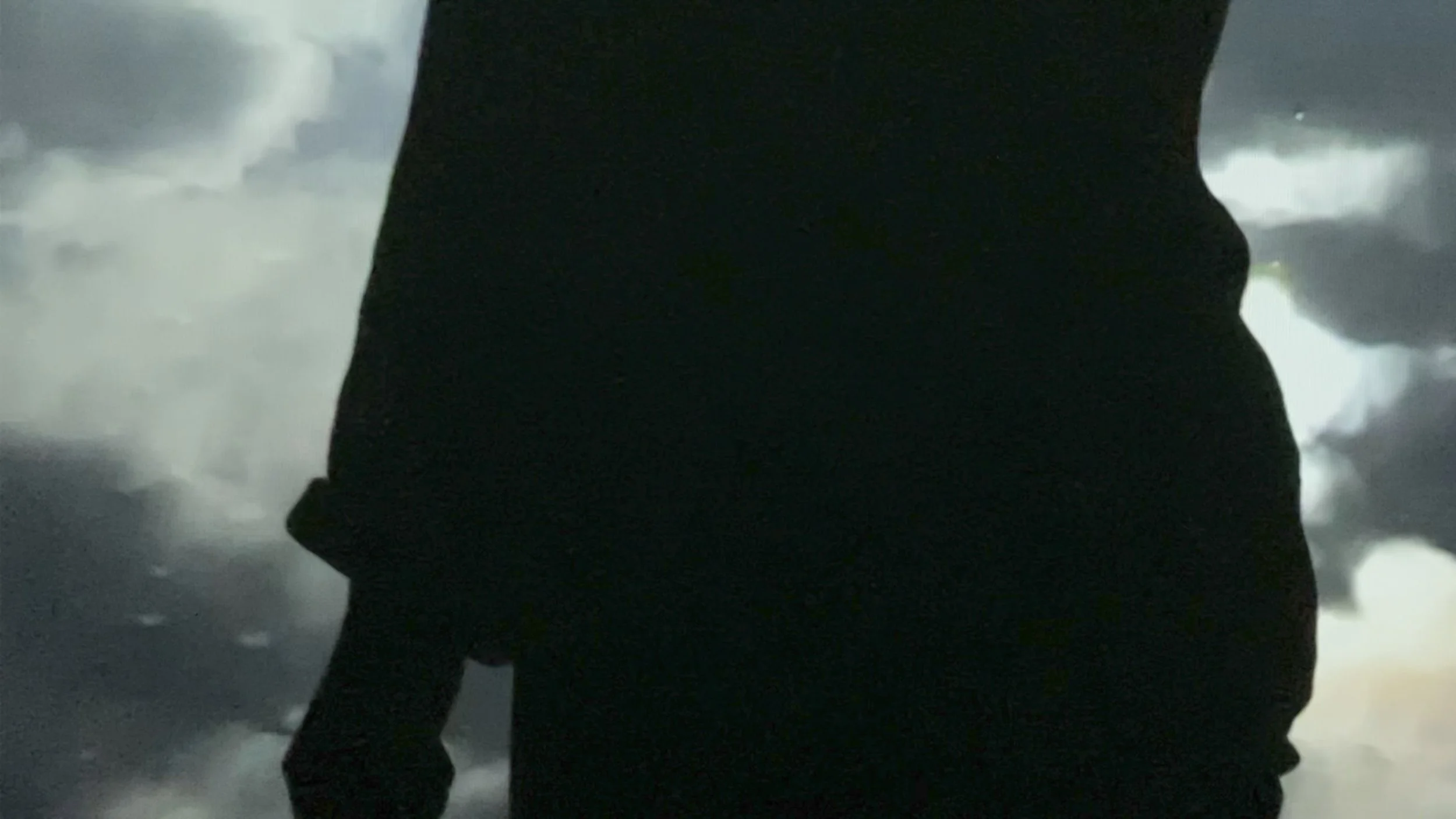
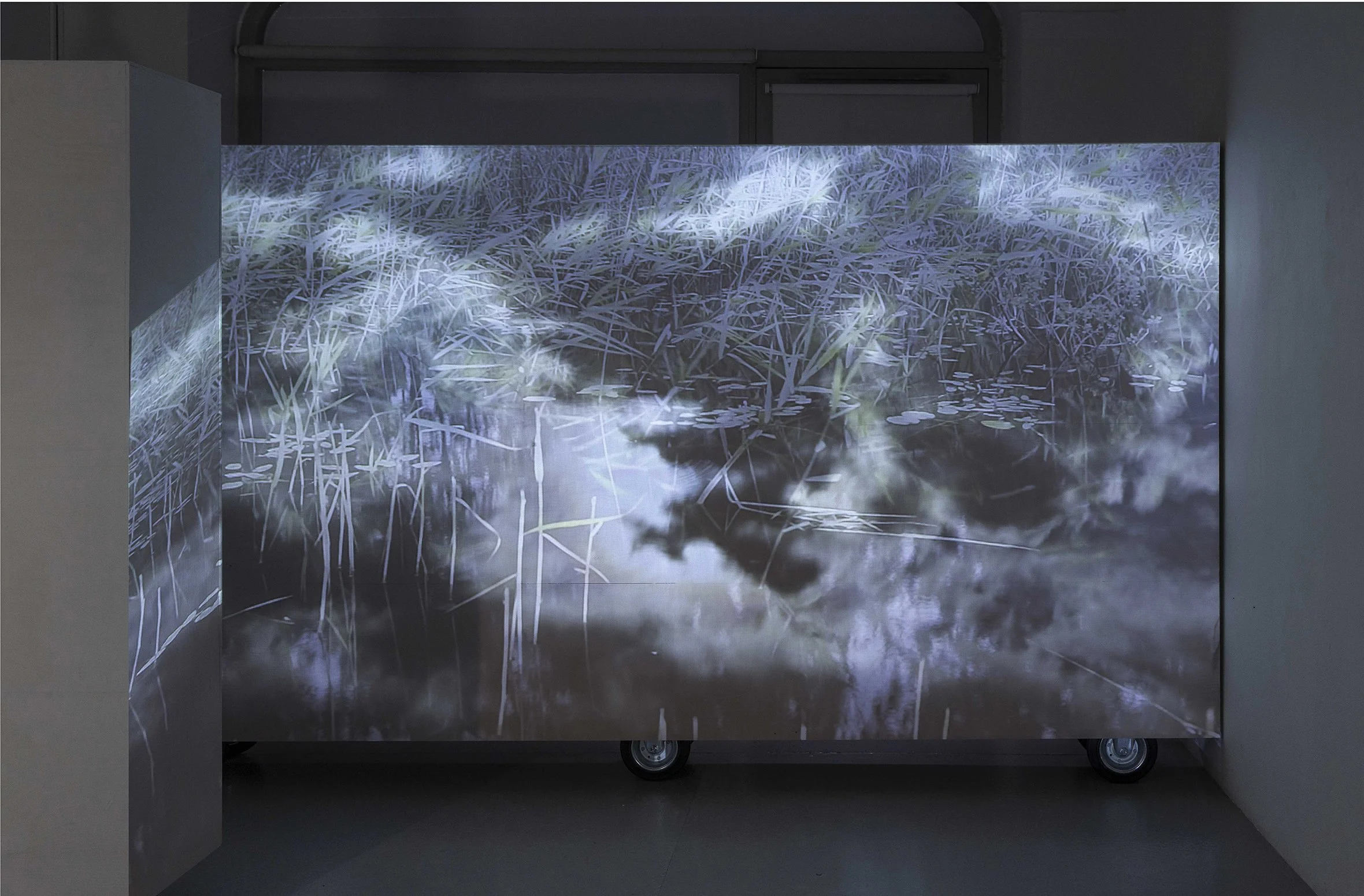
The entrance is almost blocked from within by a large wall mounted on wheels. Beyond it, a second mobile wall redirects visitors along a zigzag path. This architectural arrangement immediately draws them into the work. Turning deeper into the passage, they encounter a digital projection cast at a low angle toward the entrance. As the visitors cross it, their bodies interrupt the image, casting dark shadows onto the projection.
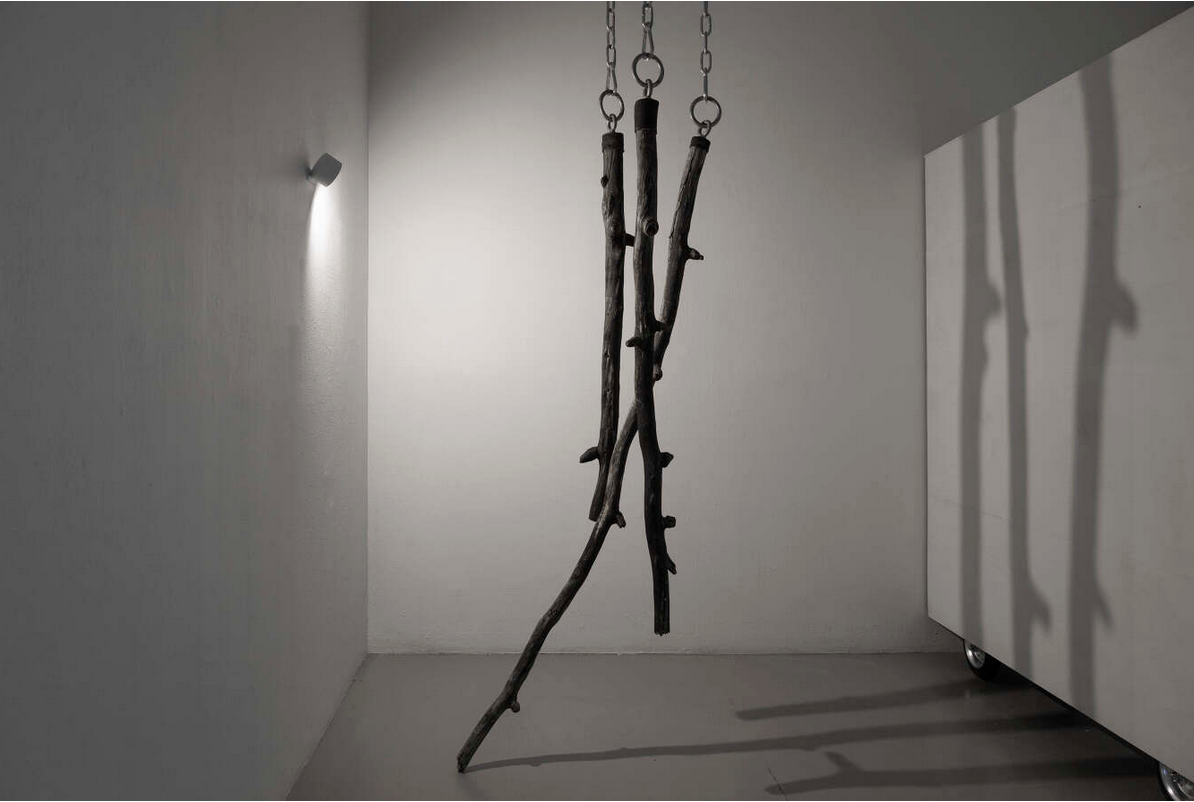
This is how Sediments (2025), a mixed-media installation by Anna Ridderstad, received its visitors at ID:I gallery in central Stockholm. Beyond the projection hung two suspended sculptures composed of alder trunks, eroded and blackened after years submerged in water. Each occupied a distinct zone within the gallery, illuminated by a spotlight that cast a sharply defined shadow onto the gallery walls. The trunks, held to the ceiling by iron chains, steel rods, and leather straps, hovered between weight and levitation.
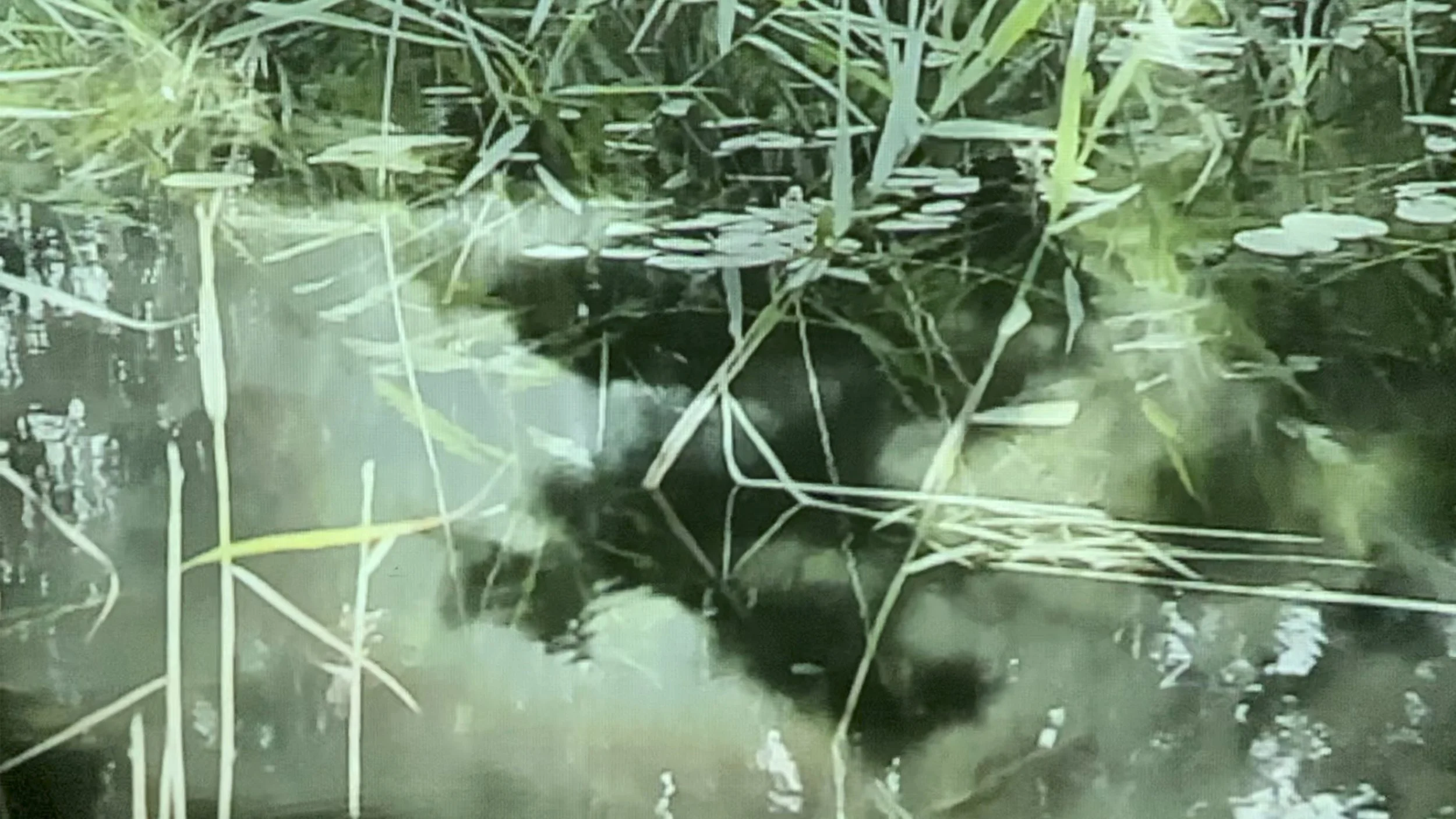
The projected video alternates between images of various plants moving in the wind or beneath the water, some fully submerged. Reflections of the sky and clouds appear on the surface of an abstract body of water. The horizon and shoreline never come into view. Instead, the framing remains in extreme close-up, slowly cross-fading from one image to the next and fusing them into a continuous, fluid sequence. A tension emerges between the suspended alder trunks,[1] held motionless in space, and the mediated movement of the projected vegetation. Through this interplay, the installation oscillates between material presence and representation.
The two largest volumes in the gallery are the walls on wheels. Their flat, upright surfaces make them ideal projection screens. Volumes like these are a recurring element in Anna's work, reflecting her engagement with Minimalism's concern for geometry and spatial perception. As architectural interventions, they also appear in earlier works such as In Level (2023) and Horizon (2021). They function simultaneously as markers of human intervention in the landscape and as abstractions of phenomenological conditions such as the horizon or sunset.
Keeping with the projection, the moving image is repeatedly interrupted by visitors' shadows, emphasizing the contrast between the flickering vegetation and the stillness of the suspended trunks, like dead bodies whose outlines the eye might momentarily read as animal or human. These perceptual effects begin to frame the installation around questions of time, offering, and participation.
I found a way.
What if I imagined my body buried underground or deposited beneath a lake, as a temporary concentration of matter and nutrients that persists longest in bones?
My bones, among other processes of life. Coalescing within sedimentary time.
Bacterial translocation driving putrefaction from the inside out. Or partially arrested decomposers slowed by an oxygenless environment.
Harboring an intimate desire to become landscape. Metabolized by the earth.
But what about the others, humans like me?
Continuity
“An imagined landscape, then, is a landscape not of being but of becoming: a composition not of objects and surfaces but of movements and stillness, not there to be surveyed but cast in the current of time.”
― Tim Ingold. Imagining Landscapes: Past, Present and Future
With Sediments, Anna creates an insular space dedicated to Skedemosse, a “place that has been sea, lake, and wetland, and which currently comprises fields and meadows with a marked hiking trail indicating where the gateway to the divine once lay.”[2] This single sentence frames her interest in landscapes as reconfigured through geological, ecological, and human processes. Archaeological and geographical accounts describe Skedemosse as a postglacial sea and lake that gradually became a wetland and bog before eventually being drained for agriculture.[3] Today, it is one of the most significant Iron Age archaeological sites in Scandinavia.
Prior to Sediments, Anna engaged with bog and ritual wetland landscapes on Öland in 2022 as part of the collaborative project Past and Presence (2022–2023), which investigated the landscape, history, and ecology of northern Öland’s Iron Age ritual sites.[4] There, she worked at Möckelmossen, the last major bog on Öland that has not been drained. Skedemosse, by contrast, lies in the middle of the island and has undergone successive transformations since the Iron Age—transformations that Sediments investigates.[5] In Anna’s words, it is “a here and now relating to a place.”[6]
Skedemosse began as a shallow, chalky lake on Öland's limestone bedrock. Over centuries, the basin filled with lime-rich mud, then peat, as water gave way to land. Within this compressed sediment, Iron Age communities deposited weapons, gold rings, and sacrificed horses, humans, and other animals. Waterlogged, oxygen-poor conditions slowed decomposition, preserving these deposits as sediment accumulated.[7] Apparent quiescence, then, emerges through material transformation. In this sense, sediment can be thought of as burgeoning stillness.
Within the installation, the suspended blackened alder trunks materialize this process. Fallen trees darken in Öland’s calcareous, anoxic wetlands as iron compounds and tannins become fixed within waterlogged wood, preserving them in peat.[8] Suspended by chains and illuminated with hard-edged spotlights, the trunks cast sharply defined shadows across the gallery walls. Their vertical silhouettes recall Scandinavian runic monuments, transforming the gallery into another site of inscription and remembrance.
I imagine our bodies settling into future strata.
But to imagine a stratum of human remains—the thought revolts me.
A horizon of decomposed flesh and mineralized bones. My imagination hesitates.
I would need to compost my body. Become humus rather than a fading monument of bone.
The humus of me could be taken up by a tree.
I would surely ask a beloved one to do just that: select a landscape spot and disperse me.
Sediments reconfigures Anna’s earlier spatial strategies—mobile walls and thresholds in Position (2014) and Omformning (2013) that disrupted perception and foregrounded bodily stance—through the ecological archaeology of Past and Presence. Where those works probed stillness and latent transformation within constructed environments, Sediments displaces this inquiry into Skedemosse’s stratified landscape, treating the mobile walls as mediators of deep time.
The projected vegetation extends this temporal logic. Moving images of plants—submerged, swaying, reflected—unfold in slow crossfades, denying any fixed horizon or shoreline. The visitor’s shadow, passing through the projection, momentarily interrupts this vegetal continuum. Rather than representing archaeological deposits directly, the shadow functions as a temporary presence, enacting a body descending into Skedemosse, joining the layers of sacrificed humans, animals, and objects preserved within the wetland. Crossing the installation is analogous to crossing a threshold: from the visible landscape into the liminal domain in which offerings passed between the human and more-than-human worlds.
Bogs, fens, and Scandinavian wetlands more generally occupy an ambiguous position between land and water. Anna describes them as “the opposite of order,” embodying “both and” or “neither nor”—neither solid ground nor open water.[9] Depositing offerings in such environments meant placing them within a medium of continual transformation, where objects could sink, disperse, decay, and become incorporated into the ongoing formation of the landscape.
Agency
Plant life assumes an unusual prominence in Sediments, both as material presence and as mediated image. The suspended alder trunks constitute the installation's most substantial physical bodies, while the mobile walls support projections of living vegetation in continual motion. Anna stages two vegetal temporalities: preserved wood and living plants still immersed in ecological cycles. She presents them as different temporal states within sedimentation.
This emphasis on vegetation also reconfigures the spatial concerns of her earlier work. The mobile walls remain architectural devices, but they increasingly direct attention toward vegetal forms rather than enclosing space. The projected plants and suspended alder trunks shift attention away from built structures toward the slow transformations of the wetland. Roots stabilize the ground, peat accumulates, and fallen trees persist within oxygen-poor soils. Spatial organization appears to emerge through ecological processes themselves. Architecture is realized, then, not as an exclusively human enterprise but as the co-production of geological, hydrological, vegetal, and human processes.
But what if the tree dies?
Dispersal would have to happen without expectation.
Composting as transformation rather than permanence.
So, then, I imagine not deciding what becomes of humus.
— Anonymous performance
Process
Anna has identified Gordon Matta-Clark as an important reference in her artistic practice.[10] From this perspective, Matta-Clark’s notion of anarchitecture offers another way of understanding Sediments’s concern with landscape: architecture is inseparable from the material, social, and environmental conditions that produce it.[11] Landscape formation encompasses human intervention alongside geological, biological, and climatic processes.
Within Sediments, this perspective displaces architecture from its conventional role as the measure of space. The installation does not oppose the built environment to nature; instead, it situates architectural intervention within the same sedimentary continuum that preserves wood, accumulates peat, and records ritual deposition. Architecture becomes another temporal layer in landscape formation, subject to the same processes of transformation, incorporation, and eventual disappearance as the ecological systems with which it interacts.
Seen within late twentieth-century sculpture, Sediments can be understood through a dialogue between Minimalism, Gordon Matta-Clark's anarchitecture, and Arte Povera. Anna’s earlier work employs minimalist geometry, bodily perception, and architectural framing; here those devices mediate ecological processes. Mobile walls cease to function as autonomous volumes and instead frame waterlogged wood and projected vegetation, redirecting perception toward sedimentary processes.
Among the artists associated with Arte Povera, Giuseppe Penone offers a revealing point of comparison. His Continuerà a crescere tranne che in quel punto (It Will Continue to Grow Except at That Point, 1968–78) stages sculpture as an ongoing collaboration between artist and living tree, whose continued growth transforms the initial human gesture. Sediments begins where such collaboration has already ended. Its suspended alder trunks no longer participate in vegetal metabolism but bear the material record of wetland processes. The chains emphasize this distinction: rather than resisting human intervention through growth, the alder bears witness to preservation, mineralization, and ecological succession. Agency resides less in the wood itself than in the sedimentary, hydrological, and microbial processes it records.
Both artists reorient perception away from plants as passive background toward their constitutive role in shaping worlds. This shift challenges “plant blindness”, the tendency to perceive vegetal life as scenery rather than as an active force in ecological and historical processes.[12] Penone locates agency in the living tree's continued growth; Anna locates it in the ecological processes that preserve, transform, and incorporate vegetal remains into the formation of the landscape. Sediments redirects attention from visible movement to the slow work of sedimentary time
Formation
Sediments presents landscapes as living assemblages through which history accumulates. The installation dissolves familiar distinctions between organism and environment, life and death, preservation and decay, revealing them as successive phases within sedimentary processes. Visitors enter this continuum only momentarily, their shadows briefly joining rhythms that vastly exceed the human lifespan. In doing so, the work situates human existence within ecological time rather than positioning it above or outside it. This reorientation also carries an ethical consequence. If wetlands preserve bodies, generate peat, sustain vegetation, and record human actions across centuries, they cannot be understood merely as resources, archaeological archives, or landscapes awaiting management. They emerge instead as active participants in the production of worlds. To recognize their agency is to acknowledge obligations toward the ecological relationships that sustain them. Ecological justice, from this perspective, entails safeguarding the conditions under which more-than-human communities continue to unfold.
Sediments cultivates a form of attention attuned to slow vegetal growth, microbial decomposition, mineral exchange, and sedimentary accumulation, resisting nostalgia for an irretrievable past. Against the accelerating temporalities that characterize the Anthropocene, the installation invites viewers to inhabit longer ecological durations and to imagine themselves not as masters of the landscape but as temporary participants within its formation. In this sense, Sediments is not only an archaeology of wetlands but an ethics of coexistence grounded in continuity, reciprocity, and shared material becoming.
Antar Kuri. Montevideo 2026
———————-
Notes:
[1] Alnus glutinosa, commonly known as black alder or European alder, is a deciduous tree native to Europe (including Scandinavia), western Asia, and North Africa. It grows best in wetlands, along rivers, and in other waterlogged environments, where its dark bark and small cone-like seed clusters are distinctive features. (link)
[2] Anna Ridderstad, artist statement for the exhibition Sediment, ID:I Gallery, Stockholm, 2025.
[3] For example, a report that presents sedimentological, pollen, and archaeological evidence from Mesolithic Skedemosse, documenting its ecological transition from postglacial lake to wetland environment. Kalmar läns museum, Mesolitikum vid Skedemosse (Kalmar: Kalmar läns museum, 2022), (link); or a peer-reviewed research article providing evidence for the long-term ecological and land-use changes across Öland. Johansson et al., "Semi-Natural Grassland Continuity," Landscape and Urban Planning 84, no. 3–4 (2008). (link).
[4] Past and Presence, a collaborative project by Ebba Bohlin and Anna Ridderstad, is described on the project's website (link) as focusing "on an abandoned Iron Age village and a ritual site where sky and sea meet behind a separating wall."
[5] Skedemosse is protected as part of the European Union's Natura 2000 network. (link) This means that a further transformation of Skedemosee could be rewetting.
[6] Ridderstad, Sediment.
[7] This can be investigated further in the following sources: Hagberg, "Skedemosse – en första presentation," Fornvännen (1961): 237–255 (link); Länsstyrelsen Kalmar län, Limestone and Fossils in Öland (link); Historiska museet, "The Gold of Skedemosse" (2025) (link).
[8] Broda, M. "Conservation of Waterlogged Wood—Past, Present and Future Perspectives." Forests 12, no. 9 (2021): 1193 (link). Not a specific source for Öland wetlands, but a generalization that seems to fit.
[9] Ridderstad, Sediments.
[10]Anna Ridderstad, email message to Antar Kuri, May 2026.
[11] In the mid-1970s, during New York’s economic crisis and the rise of urban renewal, Gordon Matta-Clark introduced anarchitecture as an affirmative gesture—opening space for collective imagination, direct action, and the poetic reoccupation of the city’s abandoned structures.
[12] In 1998, botanist-educators James Wandersee and Elizabeth Schussler named “plant blindness” our habit of not seeing plants. Fueled by visual bias and “zoo-chauvinism,” it ties cognition to eco-phenomenology and critical plant studies, keeping plants invisible in human cultures that depend on them. Read about it in the Journal Article by William Allen in BioScience, Volume 53, Issue 10, October 2003, Page 926 (link)
———————-
Image List:
All images courtesy of the Artist unless otherwise noted.Images 1-6 Sediments (2025), mixed-media installation ( ID:I gallery). Photos courtesy of Sonja Hesslow.
———————-
Anna Ridderstad(b. 1976) is based in Stockholm, Sweden, and works with installation, sculpture, and photography. She is involved in the artist-run scene in Sweden, with solo exhibitions at Gallery 54 (Gothenburg) and Konstnärshuset (Stockholm), and has participated in group exhibitions worldwide. Anna Ridderstad is part of the artist-run Gallery ID:I in Stockholm and the residency organization Nordiska Konstförbundet Malongen.