
Composition in Three Volumes: The 181 in and around Los Angeles.
16 November 2024
34.00641° N, 118.49196° W
(with the idea of approach predominant)
Volume 1: The ocean spilled all over it
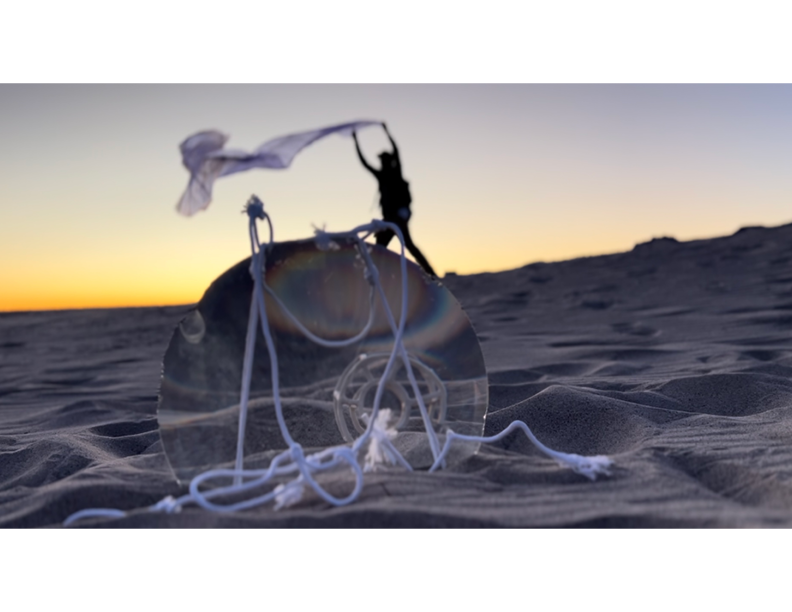
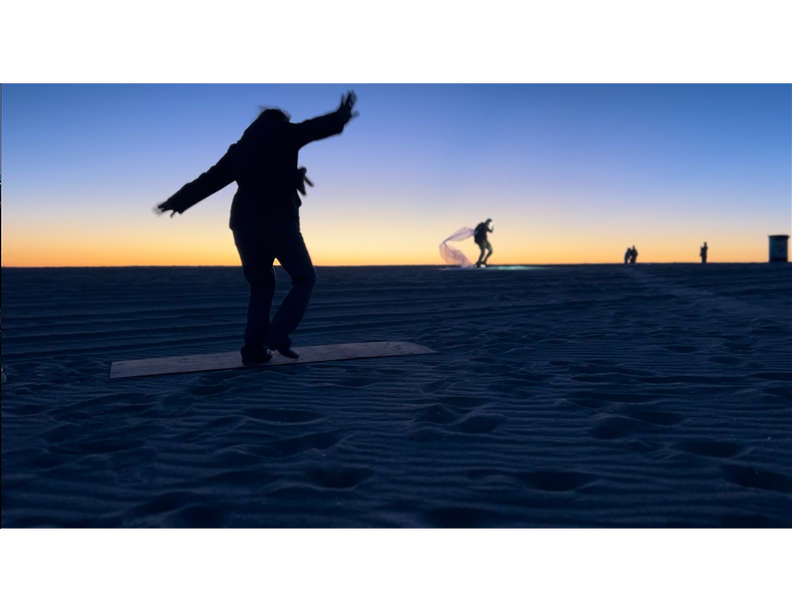
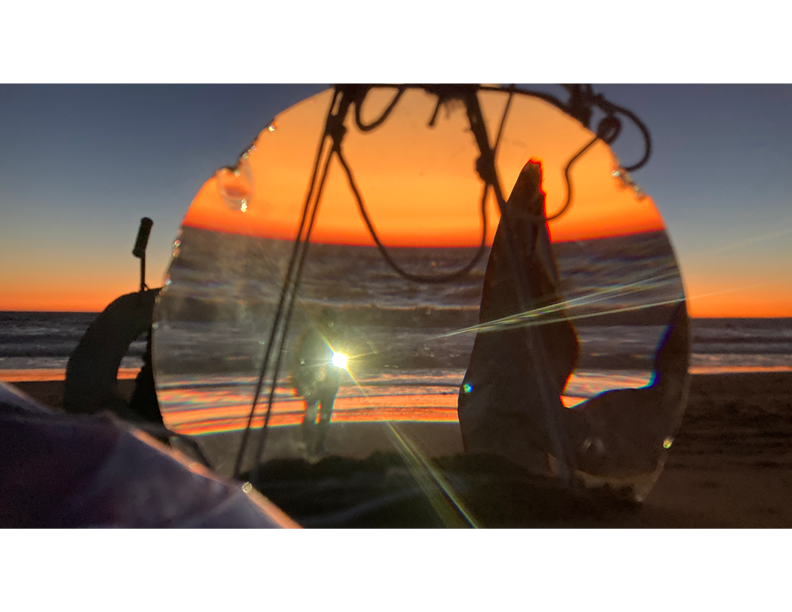
The beach, just before sunset, along the boardwalk, the Pacific is the Loudest: to be heard is to work against it. The 181 is setting up the lab, the sound lab, perhaps, a stage, also, perhaps, a transmission post, a receiving one. I plant a shovel and lay down the plywood plank against a protruding cement lip, a ripple in the landscape, halfway between the boardwalk and the water. The dancer arms her feet with tap shoes and tests the plywood against the crashing waves. The kick-ball-changes knock hard against the water and wind and salt and other masses that toes and heals can’t penetrate. A performer, not quite a cosmonaut, lays the ground, unfolding lines, sometimes pulling, mostly dragging, and pushing toward the edge: it gets louder as the day grows shorter. Is the reflective surface – at the top of the sand tower – most certainly built to help geolocate all masses – a mirror as well? Only those with walkie-talkies know for sure. I see them speaking. I try to listen. It is night, and very bright looking away from the shore. I track the long orange tail (of a sun?) streaming away from the unquieted darkness at my back. Everything was silently recorded.
17 November 2024
34.08567°N, 118.23993° W
(mere arising [experience])
Volume 2: The valley below
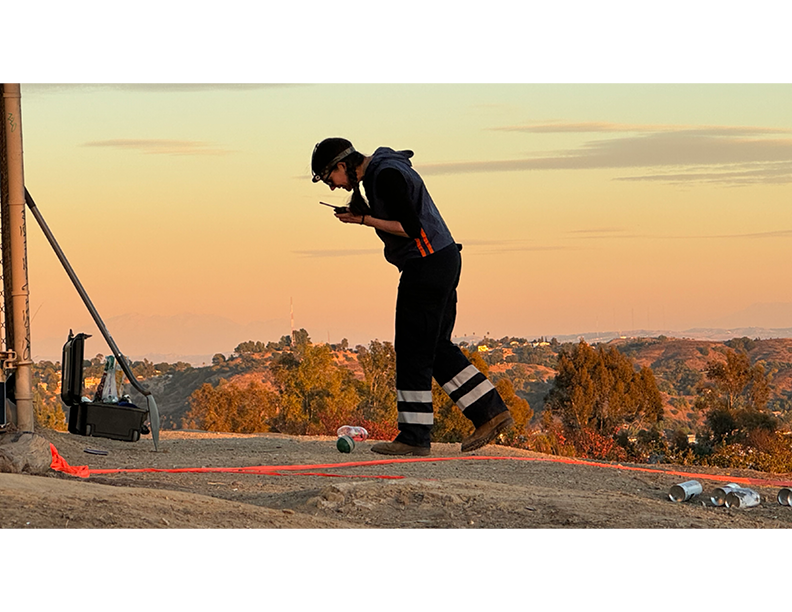
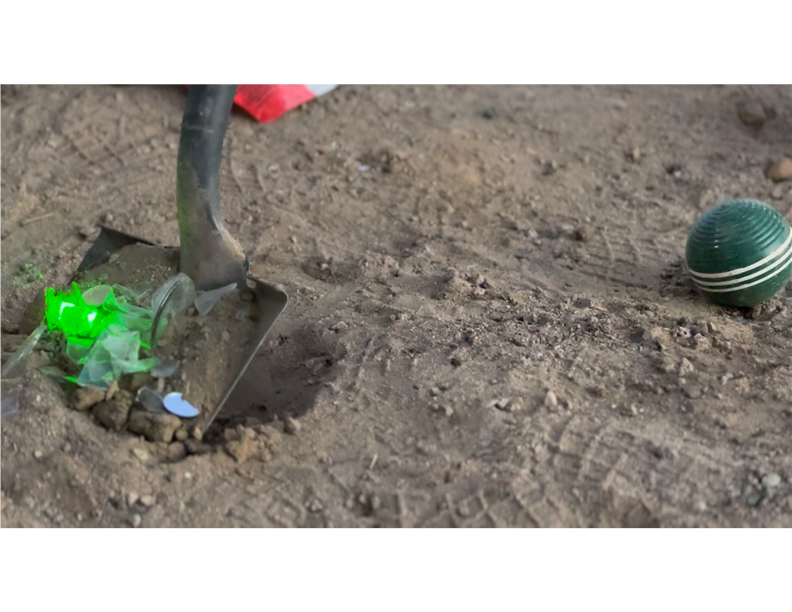
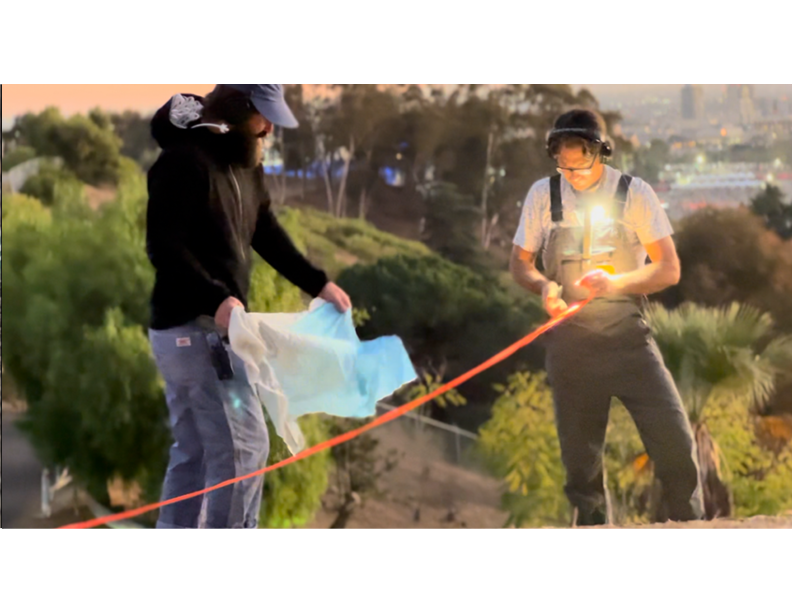
Not quite a hill but more than a sand dune where a water tank – the type that could be full – perches at the end of a fire road. Alright, I hear the 181: mallets, cables, headphones, antennae, non-antennae, rollerblades. I use the shovel as a climbing stick. In the valley – it is no less than a valley – Andre 3000 plays his flute; thousands follow and make their way through tiny white gates and gather around tiny rollercoasters. Digging upward, the dune transforms to look as somewhere else, somewhere greener, bluer than it is. Like stepping off a merry-go-round, my legs finally land on firmer ground, around the curved edge of the tank. The shovel can rest before it becomes a drum. The orange stream is now part of the message; it has become the sentence, blowing in the wind, the sentence is blowing in the wind: letting the ones below know that there is a way up, if not out. Taps and scratches, beeps (can it be another flute?), shoes and boots against glass bottles, against spray cans: can be heard. This is the ledge, the ripple, the mid-way point. All is coming in and going out loud and clear.
18 November 2024
34.2516827°N, 118.6184718 ° W
(which it is sung)
Volume 3: The last bit is not a mirage
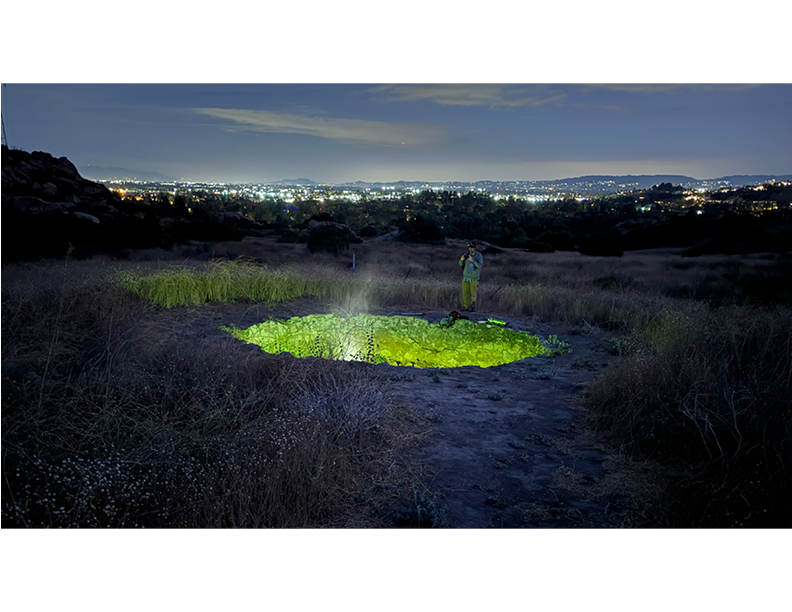
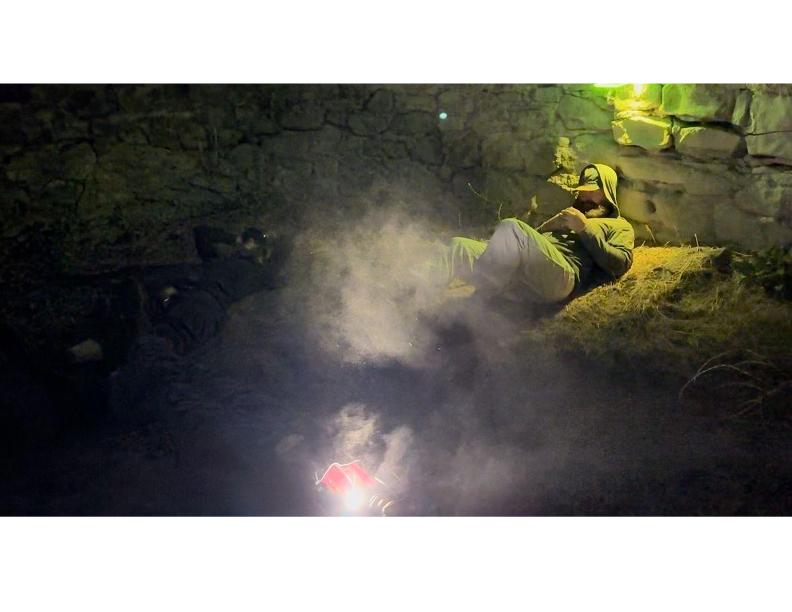
Last-minute location change: from Fred and Ginger’s grave sites to the open Chaparral a mile out or so. Our poor planning is quickly rewarded with a square foot of honeycomb – it will be used in the well, rubbed against its rippled stone wall, not too far from a sagebrush bush home to a quail choir. Come to find out, everything is useful below the surface. The rim is oval-toward-round, wide enough to lie down in it, deep enough not to be seen when lying down in it. Before descending, it seems important to record the perimeter, the dust in the space between ground and sky; all instruments come into play – the shovel (suddenly relieved it is not in a graveyard,) the modulators, antennae and other stick-like verticals –everything and everybody is prospecting along the magnetic edge, dowsing: tremolo arms, cliquing tongues, screeching quails, light-fall, bats out, in unison, they all fall down. Down in the well, there is no echo. Where is the water? is replaced with is there water? Under underground dust, looking up at Old Man’s rock, a distant glow, of stop lights and stars, of uncertain orange. Bursts of green flashes spike the landscape where all is heard and seen as one.
Gioj De Marco,
June, 2026.
—————————-
Bibliography
Anderson K. (2015). Ethics, Ecology, and the Future: Art and Design Face the Anthropocene. Leonardo 48 (4): 338–347
Fisher M. (2008). Capitalist Realism: Is There No Alternative?. Zero Books
Friedberg A. (2006). The virtual window: from Alberti to Microsoft. MIT Press
Lemu, M., & Ngwira, E. (2019). Row: a thinkivist art intervention. Nordia Geographical Publications, 47(5), 39-54.
Lèvi-Strauss C. (1994). The Savage Mind. Weidenfeld & Nicolson
Steyerl H. (2009). In Defense of the Poor Image. e-flux journal #10
—————————-
Image List
All images courtesy of OzhopéImage 1 - Submergent Poetry — Soil — 2022
Image 2 - Cimawamawa - Bringer of Good Tides— 2025
Image 3 - Dugout Canoe (detail) — 2022
Image 4 - ROW 1.
Image 5 - Ancestral Spacetime Shuttle — 2023
Image 6 - ROW: A waterlogged anti-patois-bourgeois epic in 5 parts — 2023 (still from part 4)
Image 7 - ROW: : A waterlogged anti-patois-bourgeois epic in 5 parts — 2023 (still from part 5)
The Ozhopé collective is Tavwana Chirwa, Desderio Galagade, Hamilton Kameza, Massa Lemu, and Duncan Mabvuto. Ozhopé has also been Ella Elidas Banda, Paul Chimbwanya, Prudence Chivasa, Augustine Magolowondo, Emmanuel Ngwira, and Trevor Sindo. Ozhopé is the mtondo makers of Zalewa, the potters of Namadzi, the fishers of Lake Malawi, and all those who contribute in various ways to our creative processes.