
Quiver-and-Hold: Naïve Tricksters’ Decoys in Inbar Hagai’s “Captured Show”
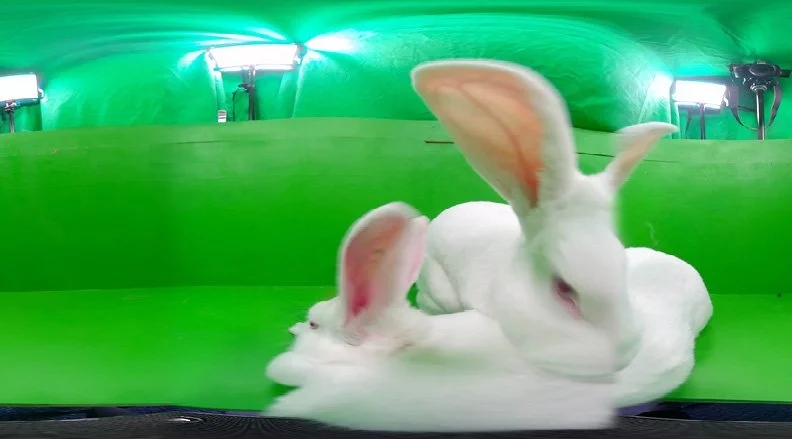
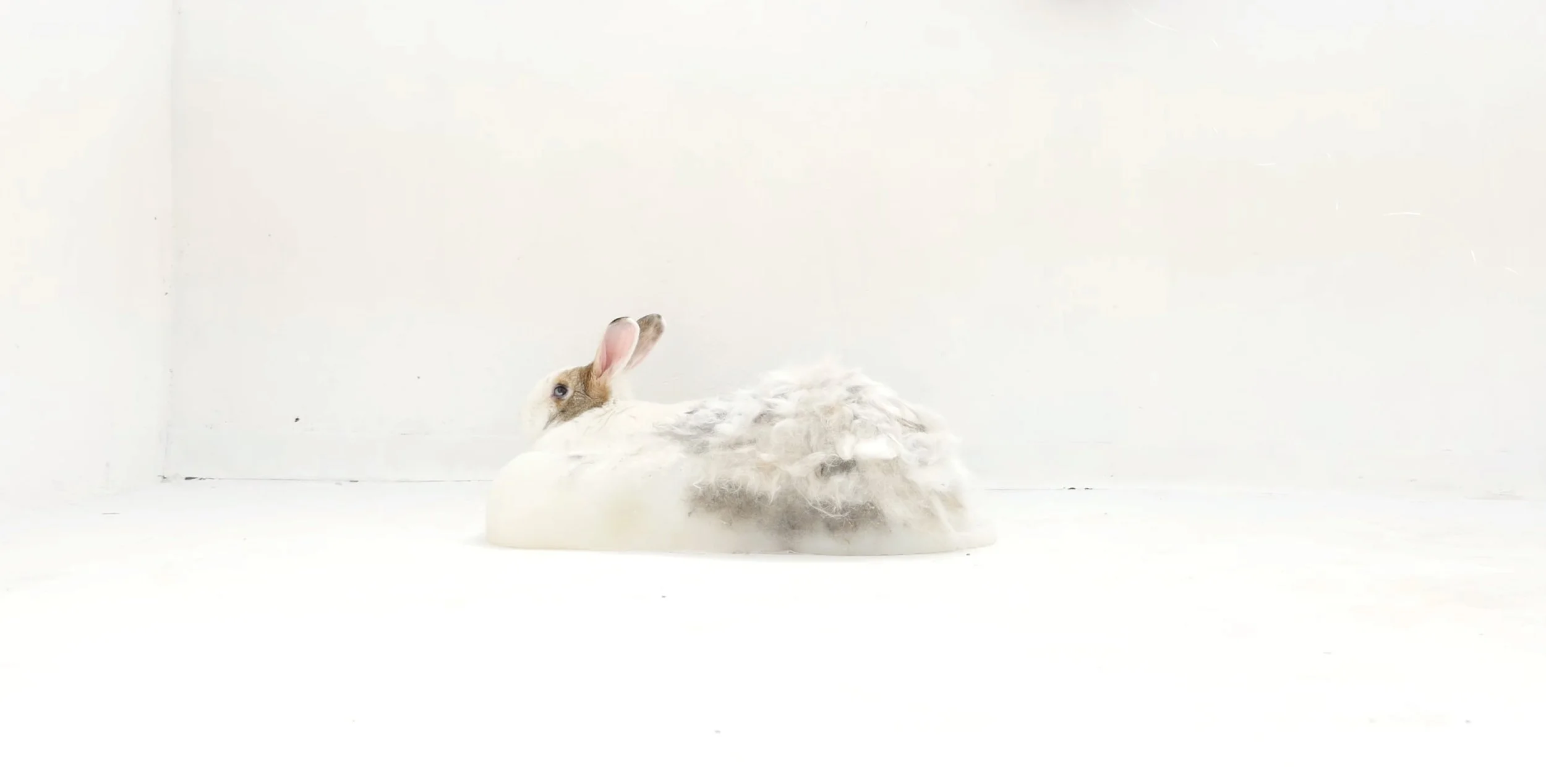
Inbar Hagai’s experimental short documentary, Captured Show, began as a next step in the inquiry of her prior work, The Decoys—to revive the libido of her neutered pet rabbit, Dudu. In The Decoys, Hagai created a mock rabbit “essence” with a mound of Dudu’s own feces and fur (Image 2) to entice Dudu to mount it; she figured this would be more alluring to him than, say, a plastic rabbit-shaped toy that might symbolize “rabbit” to humans. While Dudu didn’t take the bait, Hagai’s camera captured a moment where the mound looks like a seamless extension of Dudu’s body. Failing to be a true sexual encounter, the illusion nonetheless mimics or suggests a meeting or melding; human viewers might experience a beat of uncanny recognition, perhaps even wondering whether Dudu was “aroused” by “another rabbit.”
In reality, however, bucks (male rabbits) aren’t aroused by their own feces or fur. Was Hagai’s errant aim—to sexually arouse a neutered buck with his own non-arousing sheddings—wholly naïve, or trickster-like? While this decoy dud failed to fool Dudu and foreclosed any new knowledge about his libido, how a human—artist or viewer—is fooled would be revealed by their preformed expectations around both Dudu’s encounter with the decoy and video in general. Participants’ projected expectations can, however, remain entirely private, while the video of Dudu’s encounter remains the only “real thing” or common referent among them. Absent clarifying dialogue among all participants (humans and rabbits alike), naïve tricksters’ decoys like Hagai’s provoke an (at times anxious) ambivalence: “(How) did I/they (not) know this object, occurrence or information was(n’t) authentic versus absurd—and how or why did/could any of this happen at all?” That is, all (choose to) remain naïve or winkingly knowing—either way, opaque or cryptic—as to who is fooled by what.
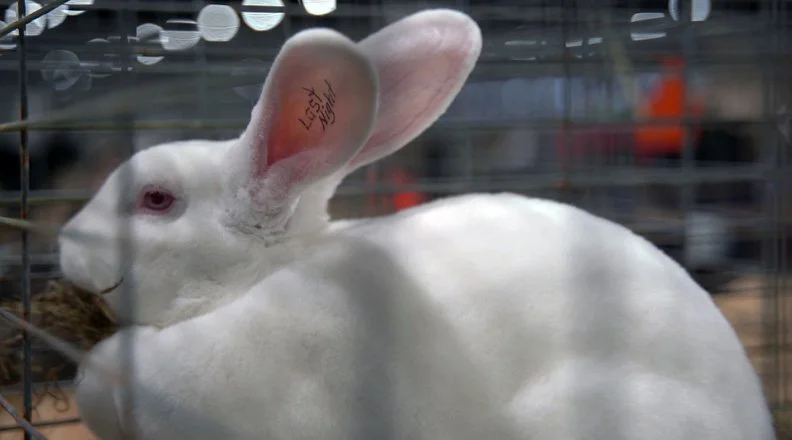
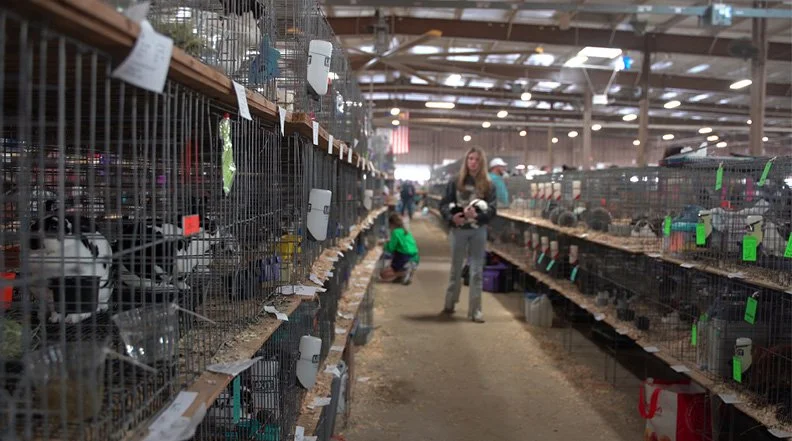
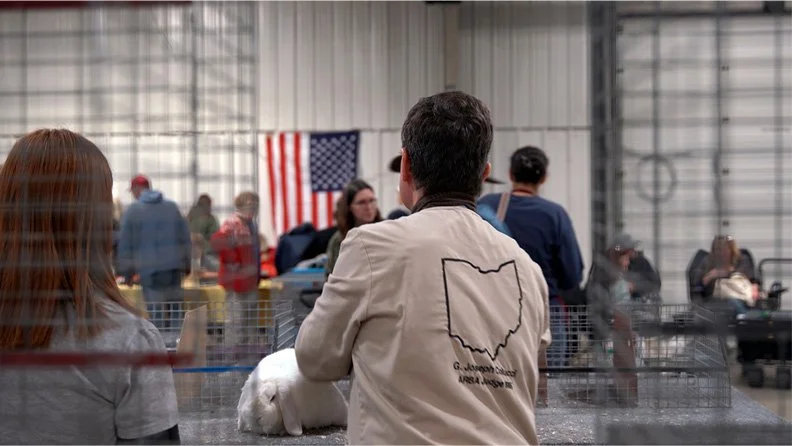
Parallel naïve tricksters’ decoys pervade Captured Show, engendering many moments of anxious ambivalence. In a further attempt to create a sexually enticing encounter for Dudu, Hagai sought to record audio of rabbits mating at the 2023 American Rabbit Breeders Association (ARBA) Convention in Louisville, Kentucky. There, over 22,000 purebred rabbits—caged, arrayed and/or tagged by breed, sex, age, human owner and human-given name—were evaluated (according to a manual titled “Standard of Perfection”) by licensed judges. This teeming encyclopedia of rabbit information—engineered to appear self-evident (the meticulously sorted rabbits are right there), sophisticated, even reverent—is unreadable to an outsider novice like Hagai. Like Dudu with the decoy in Hagai’s white cube, rabbits at the convention could only move or be handled in physical and conceptual frameworks created by and for humans—the rabbits, like Hagai, perhaps also only detected the presence of unreadable information. While Hagai was welcomed by organizers to freely penetrate and film an event showcasing rabbit “knowledge” and “excellence,” the convention operated orthogonally to—or even against—rabbits’ and her own nature. (How) are the organizers, breeders, judges, rabbits, Hagai, and viewers of Hagai’s film fooled by the convention-as-decoy?
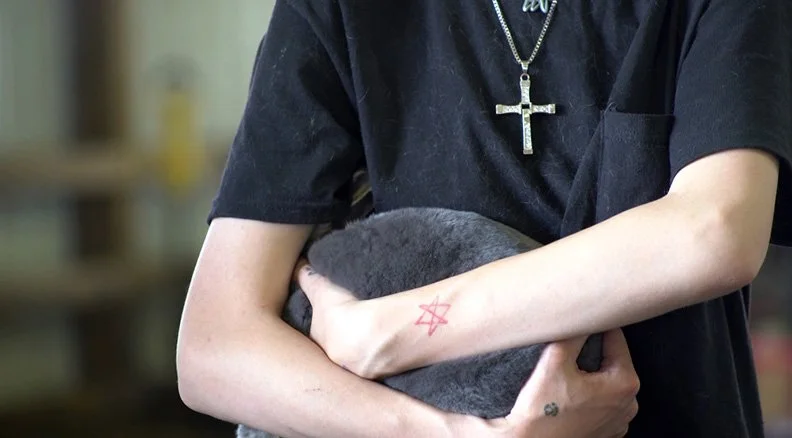
A unique “naïve trickster’s decoy” dialect recurs in the context of the convention, where rabbits, their breeders (virtually all white Americans, many Christian), and Hagai (a Jewish queer woman of Iraqi-Tunisian descent currently living in NYC) unusually converge. As Hagai roamed the exposition center, her two cameras (one often left stationary) captured, in tight to wide shots, rabbits’ noses, ears, tails and other body parts quivering. Adaptively multipurpose responses to their environments, rabbits’ quivers might indicate joy, interest, excitement, anxiety, fear, pain, being too cold or hot, surveillance of sounds or scents (of predators), or even hiccups. Some people can decode a particular rabbit’s quivers; many cannot. In Hagai’s film, judges quell rabbits’ fidgets by holding their ears. While rabbits’ stillness under (lay) human handling may belie paralysis indicating (more) intense fear, ceased fidgeting tends to signal relief and rest to humans, so from (lay) humans’ perspectives, holding rabbits into stillness may often appear benevolent. Visual rhythms of rabbits quivering and holding themselves, or being held, motionless ripple across the center; whether their quivers to holds signal shifts from agitation to serenity, joy to paralysis, or pain to bliss, only some human participants can tell—and only some can discern whether others can tell. The convention’s “naïve trickster’s decoy” dialect can thus be identified as “quiver-and-hold.”
Magicians also employ quiver-and-hold, twitching their hands over “empty” hats and pulling rabbits out (by their ears). Such absurd and known-to-be false transitions nonetheless appear seamless, legibly coded, “family friendly” and even admirable. Our enjoyment is satisfied by the novel convergence of a magician, a hat and a rabbit—we’d prefer not to interrogate and “spoil” the illusion. Hagai employs jump or quiver cuts, sans linear arc, in a similar fashion—she didn’t initially “get what is going on” at the convention, and neither will many viewers of her film, but enough legible indicators of “community,” “contest,” “organization,” “leisure,” “pet” and so on converge to offer moments of uncanny recognition.
When participants foreign to each other convene in certain contexts—as did Hagai, the breeders and rabbits—the “naïve,” “trickster” and “decoy” become indiscernible among them. To lubricate or enable relation at all, all participants—with varying degrees of awareness and volition—acquiesce to, rather than challenge, the absurdity of their encounter. Operating throughout the convention and Hagai’s film, the logic of quiver-and-hold redirects participants’ attention from inconclusive flutters between “naïve” and “trickster” toward nonthreatening decoys that inspire uncanny recognition, awe or amusement as appeasing spells. Unspeakable, reflexive affects—including shock, anxiety, fear, anger, confusion, morbid curiosity or titillation—are sublimated or subdued via shudders into holds mimicking unguarded presence. Quiver-and-hold thus fabricates a convenient—perhaps even necessary—illusion of continuity: quiver, hold, repeat.
Dialogue exchanged by quiver-and-hold participants is rarely wholly transparent. Problematic differences (or even shared conundrums) are muted and masked, and benign, charming and touristic foreignness is exchanged instead: Welcome, we’d love to share our ways with you! / Thank you for welcoming me, an outsider, into your interesting world! In lieu of disruptive interrogation, Hagai extended her camera as a decoy to humans and rabbits alike; while lacking any editorial control, her human—and at times even rabbit—subjects took her bait.
One interviewee, while brushing her faintly quivering Giant Angora rabbit on her lap, provides a testimonial championing Giant Angoras—they’d saved her from depression and garnered her a Best in Show award. She remarks that her rabbit learned to “love” being held on its back and brushed just so; in this moment, the rabbit, Hagai and Hagai’s viewers can’t confirm or disprove her claim. Hagai asks her how many rabbits her rabbitry contains, and the woman, chuckling (a form of quivering), replies that, as with a woman’s weight, one shouldn’t ask about this. But she offers, as a kind of “unreadable information” decoy: “I can honestly tell you I have, oh, ‘x’ amount of cages.” Awkward and anxious on one level, the dialogue and visuals here nonetheless yield a relatable continuity.
In another shot where Hagai’s camera holds still, a judge sends a buck hopping to and from the camera along a plank beside a row of cages; the buck’s testicles jostle before the lens a couple times, while the rest of his body pauses and exceeds the frame. Did he attempt to mount the camera—would an observer (of the event or footage) think he did? In the parking lot, Hagai filmed two breeders attempting to mate two rabbits in a hatchback car (since mating is forbidden inside the center). As the breeders voice their quivering rabbits’ thoughts while positioning them to copulate, a breeder’s rear end comes to occupy most of Hagai’s frame—while the breeders hold their rabbits’ hindquarters, Hagai’s lens happens to hold itself on a breeder’s. Across these happenings, quivers and holds rhyme—a buck mounts a camera, a buck mounts a doe (female rabbit), and a human rear alludes to mounting. While something horrifying, even humiliating, is arguably coerced in each scenario, Hagai’s viewers may be distracted and amused by the decoys—camera, car, and human rear—respectively employed in naïve or winkingly knowing attempts to document, assess, produce or critique rabbit “excellence.” On one level, our enjoyment is satisfied by the unlikely convergences of recognizable elements (rabbits, cameras, cars, human hands, voices, and rears); on another, we anxiously and ambivalently wonder: “How or why did/could any of this happen at all?”
While Hagai’s human subjects, who speak directly to her (camera), clearly consented to be filmed, the breeder likely remained naïve to the prominence of her rear in a shot, and the Giant Angora owner likely didn’t anticipate Hagai’s unconventional framing (that included odd close-ups of the owner’s face and her rabbit’s underside) or editing style. The owner delivers her narration in a style befitting a conventional, advocacy-oriented documentary built around inspiring personal story arcs, and an assumption that time and life move linearly toward ever-improving advancement undergirds the convention, from “Racing to History” in the event logo, to a judge’s remark that children, fifty years hence, will remember the historic 100th convention. To what extent does Hagai’s human (or rabbit) subjects’ consent operate as a naïve trickster’s decoy—who is fooled by the nature of the consent given, and how? If the artist, her subjects and her viewers all hail from culturally marginalized communities that are, in a sense, orthogonal to each other in “everyday life,” what kinds of anxious ambivalences emerge around creative control and consent? While Hagai would like to share her film with breeders and others beyond artists and filmmakers, would it land as “unreadable information” to those who whose educational or cultural explorations don’t include experimental film studies?
As Hagai speaks of anticipating failure in her rabbit-related projects, it may be useful to consider candidate “problems,” “solutions” and “failures” in the context of her film. Sadly and unexpectedly, in the course of this writing, Dudu died (of cancer); while not a kind of failure Hagai anticipated in relation to her quest to revive his libido, that quest has ended. A wider, subsuming, context-independent “problem” identifiable in Captured Show is the human control of (thousands of) rabbits for any human purpose, including designer breeding. Within the context of Hagai’s project, however, this problem is a decoy—one virtually impossible for her, her viewers or convention participants to solve, or even define (when and where did the problem “originate,” and how can we “go back,” or “restore what was ‘lost?’”). Releasing thousands of caged or domesticated rabbits into “the wild” (wherever that may be) is typically deadly for them, given their underdeveloped outdoor survival instincts and skills. As with Hagai’s feces-fur decoy, this overbroad “problem” forecloses accessible solutions.
Hagai’s film, alternatively, proposes more localized, context-dependent “problems,” where solutions might be more actionable and sustainable, and “failures” might provoke novel questions or awareness. While Hagai doesn’t visually appear in her film, she includes herself asking questions in (her everyday) non-American accented English. Markers of difference—like accents—carried by women from minority, especially non-Western, cultures can be interpreted as indecipherable and untrustworthy, or as nonthreatening naivete; in the latter case, outsider women can mask potentially disruptive feelings, thoughts or aims under the cover of difference. If Hagai’s accent functions alongside her camera as a naïve trickster’s decoy, could she leverage its cover to ask more pointed questions that “activists” or “breeders”—“enemies” and “those who should know better”—couldn’t get away with? Would at least one breeder—naïvely, or winkingly knowingly—eventually disclose to Hagai their rabbit count, if they viewed Hagai as merely a curious tourist? And, could this initial “trick” engender an authentically deeper dialogue or relationship, profoundly unique to them in that place and time, that potentially shrinks gulfs between consent given and assumed, and artist and audience?
The kaleidoscopic triad of “naïve,” “trickster” and “decoy” spins round and round in virtually all our encounters, driven by an anxiety borne of(?) or refracted through(?) capitalism’s earnest/taunting, carrot/tail (decoy)-chasing query: “Who is (‘free’ to be) (most) ‘authentic?’ (Am I?) How or why did/could any of this happen at all?” Hagai’s drive to restore Dudu’s libido may reflect her desire to reroute or re-root her own quivering anxiety to a primordial, fleshy authentic core responsive to its own unmanipulated nature. While any of us may unceasingly fail to be sure we’ve fully revived the “real thing” in our own related quests, such failure is, ultimately, heroic.
Jennie E. Park
December, 2025.
——————————
Image list:
All images Courtesy of the Artists, unless otherwise noted.
Images 1 and 2: The Decoys, 2024, still image from 3-channel video, color, sound, 19:20 min loop
Image 3 to 6: Captured Show, 2025, still image from video, color, sound, 29 min
——————————
Inbar Hagai is an artist, filmmaker, educator, and moving-image programmer whose work merges video, virtual reality, kinetic sculpture and sound, installation, and experimental documentary filmmaking. Her long-term, transdisciplinary projects often meander through a sequence of narrative rabbit holes, blurring the boundaries between staged and happenstance to transgressively observe social phenomena and conventions, along with their attendant taboos and contradictions.
Hagai gained her BFA from Bezalel Academy of Arts and Design and her MFA from Carnegie Mellon University. Her films and media installations have been exhibited internationally at venues including Silver Eye, Miller ICA Pittsburgh, The Carnegie Museum of Art, The Center for Digital Art Holon, and Manifesta 11, and in film and media festivals such as PrintScreen, DocAviv, Antimatter, and On Art Warsaw.
Most recently, she was selected as an artist-in-residence at the NARS Foundation in Brooklyn, NY, and the Skowhegan School of Painting & Sculpture.